
What is happening with laser tattoo removal treatments?
As we all know, the laser energy is absorbed by the tattoo inks, and they ‘break up’. Well, something like that…
But what does ‘absorbed’ actually mean? And how much of the light energy is absorbed by each ink colour?
To answer these questions, we need to understand the concept of ‘absorption coefficient’. This, essentially, represents how strongly or poorly an ink colour absorbs the incoming light energy.
It’s all to do with quantum physics, so I won’t go into detail here. But, in essence, the absorption coefficient is a probability. It is the likelihood that an atom will absorb (or ‘keep’) the energy carried by an individual photon of light, when they interact.
That probability depends greatly on the wavelength (more accurately, the frequency!) of that photon. So, an atom in some tattoo ink, might have a very high probability of absorbing the energy from a 1064nm photon (Nd:YAG); but the same atom might not absorb a 532nm photon (frequency-doubled Nd:YAG) very well, due to a very low probability.
In other words, the absorption coefficient of that photon at 1064nm is high, while it is low at the 532nm wavelength. In reality, the absorption coefficient of any atom changes with wavelength from virtually zero to almost 100%, depending on the atom’s quantum states etc, etc, etc…
So, how does this translate to laser tattoo removal?
Well, the reality is that all tattoo ink colours will absorb all the laser wavelengths used today (Nd:YAG 1064 and 532nm, ruby 694nm and alexandrite 755nm) – to some extent.
The important point is that the absorption coefficients range enormously across the ink colours and wavelengths.
So, let’s look at some examples…
Black inks tend to absorb most wavelengths very strongly. Let’s say that a particular black ink absorbs the 1064nm wavelength with a probability of around 90%. This means that laser energy, at 1064nm, will be very strongly absorbed by that ink. Say, for this discussion, that this ink can be fully removed, in a tattoo, after five sessions.
Now, say that same tattoo has some yellow ink in it, and this ink has an absorption probability of around only 10% (at 1064nm). This means, that using the same incident fluence, the yellow ink will absorb around 0.111 (1/9) times the energy compared with the black ink.
If the black ink fades after five sessions, then, assuming everything else to be similar, the yellow ink will require about 45 sessions, if the same fluence is applied.
How do we get round this?
What this suggests is that we should be using higher fluences on those inks with lower absorption coefficients. Many laser operators automatically think that we should change wavelength.
What they are doing is precisely the same thing – choosing a wavelength with a higher absorption coefficient for that ink colour. Although, I suspect, most people don’t realise that’s what they’re doing!!
By changing to a different wavelength, you may be increasing the amount of absorption of the laser energy by the targeted ink colour. However, you might not!
There are, in fact, two choices here:
Route 1:
Stick with your original wavelength and use a higher fluence (see video). Most of us fall into the ‘trap’ of assuming that the fluence that works on black, or very dark, inks should also work on lighter ink colours too.
As we now know, that is simply not true. Lighter colours will inevitably have a lower absorption coefficient and so will require a higher fluence to achieve the same effect as with the black ink.
But the fact is that black ink is the easiest ink to excite with laser light. All the other colours are not so easy. They all require a higher fluence than black ink!
Route 2:
This is the route most people choose – change to another wavelength (if available!). As I pointed out above, this assumes that the chosen wavelength is more strongly absorbed by the target colour.
But, this may, or may not, be true. We can’t know until we try.
It may well be that some ink colour, say yellow, interacts strongly with the Nd:YAG 532nm wavelength at fluences above 5 J/cm2, whereas it only requires around 2.5 J/cm2 at the 694 nm wavelength (ruby)…
And, of course, not all yellow inks are the same!! Some may not react to the 532nm wavelength until the fluence reaches 15 J/cm2, or more!
But…..
And it’s a big but….
When we change the wavelength, we must stop and consider what is also changing. It is not merely a shift in the applied laser light colour. The way the light interacts with the skin’s constituents also changes. If we change from 1064nm down to 532nm, we need to realise that the melanin and blood vessels will also absorb more of the energy. They just do! I made a video describing this too.
If the melanin and blood are absorbing some of this energy, then there is less energy available to reach the tattoo ink. We would need to increase the applied fluence to mitigate. But this could lead to more tissue damage…
So, changing wavelength is not a trivial exercise – we must think about the ramifications of doing so.
How much do the inks absorb?
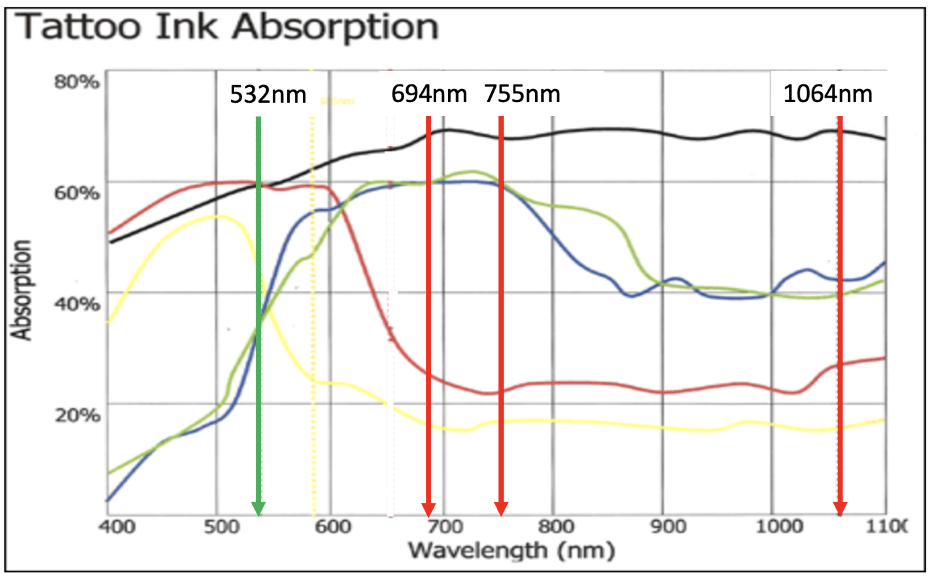
The above chart shows the absorption spectra for five ink colours – black, green, blue, red and yellow. We can see that black absorbs best out of these colours, but that its absorption drops as the wavelength falls below 700nm.
Green and blue have relatively low absorption from 900nm up, but they peak around 700nm – close to the alexandrite wavelength (755nm).
Red absorbs most strongly below 600nm – where the frequency-double Nd:YAG line is at 532nm. But it is a very poor absorbed above 700nm melanin that the ruby, alexandrite and fundamental Nd:YAG wavelengths will not be well absorbed.
Finally, yellow has low absorption for all the standard laser wavelengths since its peak absorption is down near 500nm. The YAG wavelength, 532nm, is the best option for yellow, but even this is only marginally better than the other wavelengths.

I nicked that above image off the internet. It’s quite nice but a bit inaccurate. It’s not as simple as this image portrays…
Important points:
Firstly, it is impossible to know which coloured inks are actually present in any tattoo. Our eyes can easily deceive us. Most tattoo artists mix a number of ink colours to attain their desired final colour. When this mixture is hit by a laser wavelength, the constituent colours will absorb different amounts of energy, depending on their individual absorption coefficients. Consequently, the reactions will vary between these colours and hence the fading will probably differ too.
Secondly, changing wavelengths is more than simply changing the colour of the light. For example, 532nm is strongly absorbed in melanin and haemoglobin meaning that the epidermal basal layer and capillaries are more likely to be damaged – I wrote about this in a letter to the British Journal of Dermatology (click here) a few years ago.
Thirdly, the 1064nm wavelength has some advantages over the others – it penetrates deeper than the rest and it doesn’t interact strongly with melanin or haemoglobin meaning that it is less damaging than the others.
Fourthly, the 532nm frequency-doubled wavelength form a QS Nd:YAG laser is actually a combination of both 532 and 1064nm This is simply because the frequency-doubling crystal is never 100% efficient – most tend to be around 70 to 80% efficient. So, a beam of 532nm energy will be around 75% 532nm and 25% 1064nm.
This means that a fluence of, say, 10 J/cm2, will be made up of 7.5 J/cm2 of 532nm light and 2.5 J/cm2 of 1064nm light. So, 10 J/cm2 of 532nm light energy is not equivalent to 10 J/cm2 of 1064nm light! Plus, the 532nm will interact more with the melanin and blood vessels.
Conclusion
This has probably just confused most of you reading this! The fact is, it is not trivial. Changing wavelengths is not a straightforward choice.
We never know the absorption coefficients of the inks we’re treating (unless you own a spectrophotometer…). Hence, we can never know which is the most appropriate wavelength to apply.
Perhaps the best way forward is to try different wavelengths on the colours we are treating, at different fluences, to see which responds best. This might help to improve the overall result, but it will take a little longer…
Hope this helps (a bit!!),
Mike.
Our next MasterClass will be in Luton in September. See you there…


 Mike Murphy's Blog