
There’s more…
One of my readers, Dan Jackson, asked me about pulsewidth (in a roundabout way) after my recent posts about ink colours (Part 1, Part 2). I had forgotten that the pulsewidth does have an effect on the threshold (minimum) fluences required to instigate the desired response in tattoo ink colours.
A few years ago I did a wee review of tattoo laser treatments through the decades. I found that the fluences typically used were directly related to the pulsewidths (see figure below).

Shorter pulses need less fluence than longer ones, regardless of wavelength. The shortest pulse I could find was used by Ross et.al. with an experimental picosecond laser of duration 35 ps. This was not a commercial system.
They found that they could stimulate a response using only 0.65 J/cm2, whereas a conventional picosecond laser required around 1.0 J/cm2 – current “picosecond” lasers utilise pulsewidths between 350 and 800 ps, according to their manufacturers. (Which means that they are better describes as ‘sub-nanosecond’ since these equate to 0.3 and 0.8 ns…)
Fluence threshold vs pulsewidth
So, using the same calculation method as in Part 1, but with a ‘base point’ of now only 1 J/cm2, I have recalculated the minimum fluences required to induce a response, for different pulsewidths:
| Wavelength | 532nm | 694 nm | 755 nm | 1064 nm |
| Ink colour | ||||
| Black | 1.2 | 1.0 | 1.0 | 1.0 |
| Blue | 2 | 1.2 | 1.2 | 1.6 |
| Green | 2 | 1.2 | 1.2 | 1.8 |
| Red | 1.2 | 2.8 | 3.1 | 2.6 |
| Yellow | 1.6 | 4.1 | 4.1 | 4.2 |
than around 10 ns
This clearly indicates that shorter pulses need less fluence. My original calculations were based on a study from 1990 when a ruby laser was used to determine the threshold fluence in black ink. But this system had a pulsewidth of around 40 nanoseconds – quite long by today’s standards.
Many of the Q-switched lasers we use today are in the range 5 to 10 ns, with the alexandrite and ruby lasers utilising longer pulses.
The tables show the difference between the pulsewidths – these are approximations since it is not possible to calculate these for all pulsewidths (insufficient data!!)
| Wavelength | 532nm | 694 nm | 755 nm | 1064 nm |
| Ink colour | ||||
| Black | 2.2 | 2.0 | 2.0 | 1.9 |
| Blue | 3.8 | 2.2 | 2.3 | 3.1 |
| Green | 3.8 | 2.2 | 2.3 | 3.4 |
| Red | 2.2 | 5.3 | 5.9 | 4.9 |
| Yellow | 3.0 | 7.8 | 7.8 | 8.1 |
than around 10 ns
Picosecond lasers may use even lower fluences to generate the desired reaction (in superficial ink)!
The advantage of using lower fluences is that there is less chance of collateral damage to the surrounding tissues. Every laser tattoo removal procedure results in some micro-scarring, mostly due to the physical tears caused by high-speed fragments of ink tearing through the dermis and epidermis.
Of course, fluences must be increased when tackling deeper ink. But any micro-scarring at depth will not be readily visible at the surface.
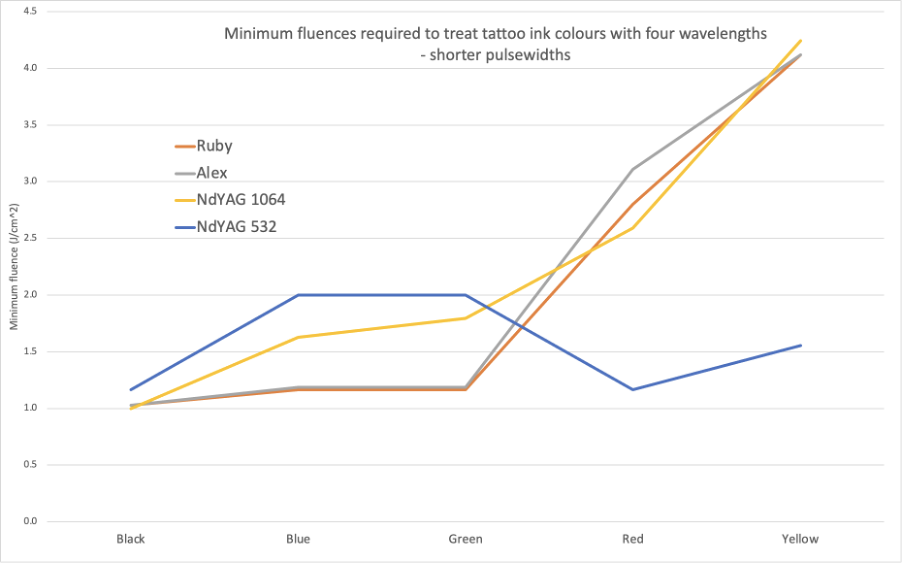
Fluences required for shorter pulses, less than 10 ns
Conclusion
Shorter pulsewidths require lower fluences to induce the reaction on the ink particles, but all wavelengths can be used to tackle all ink colours, if sufficient fluence is applied.
It is likely that short pulsewidths add more energy into the individual ink particles, before the steam production prevents further absorption (see my BMLA presentation on this stuff).
Hope this helps,
Mike.



 Mike Murphy's Blog
Question vrs comment; what are your thoughts when it comes to white ink? Specifically when it is incorporated with black, meaning surrounded by or mixed into… that is always my biggest issue when it comes to removal. I work with Quanta Q plus-C, I have 3 wavelengths and am very comfortable working with the full spectrum of color (yes some are more challenging than others and Fitzpatrick Scale is always factored in).
Are you treating at a lower energy with 1064nm and doing more treatments? Or do you prefer a different wavelength? Obviously it can blister and darken and this needs to be avoided. It is becoming such a common issue. I live in the states. I would love to attend your master class to ask this question but only recently found your page and can not make arrangements with such short notice. I have loved reading your posts and am hoping to make it to your next master class. I would appreciate your feedback or a Part 4 dedicated to this topic! Thank you in advance…
Hi Danielle,
I’ve only just found your question.
White ink is usually titanium dioxide or someting similar. These act as mirrors to the laser energy, and slow down treatments.
There isn’t really much we can do about it except explain to the patient what is happening. If the target ink is black, then I would still use the 1064nm since that wavelength requires the lowest fluence, and penetrates the deepest. However, the white ink will add more sessions overall. But I always say that we should approach these treatments with subtlety to ensure less tissue damage.
We are thinking about bringing our MasterClass to the US. We had a few people who came to the UK this year, and they all think that we could do well there. Maybe next year!
Best wishes,
Mike.