
To answer this question, we need to understand what is going on in the skin…
When light (any type) enters the skin, it encounters atoms and molecules – lots of them! As a direct consequence, the photons are scattered – their directions change. Some of them are scattered so much that they leave the skin altogether (known as ‘back-scattering’).
The remaining photons stay in the skin, and will be absorbed at various locations.
To reach the dermis, the photons must go through the basal layer of the epidermis, where a certain concentration of melanin will be found. The level of concentration can range from as low as 5% to more than 45% – this is the ‘skin tone’
Note that this is NOT the “Fitzpatrick”, as is often claimed. It is merely the concentration of melanosome in the epidermis, at that time. The Fitzpatrick type relates to the skin’s response to ultra-violet light energy – it is entirely irrelevant to most laser-light treatments.
When the photons encounter the melanosomes, some of them will be absorbed – raising the temperature of the basal layer and epidermis. The more melanosomes found there, the higher the temperature will be. In other words, darker skins will become hotter than lighter-coloured skins, for the same incident energy/fluence.
This is not good for two reasons:
- a hot epidermis can lead to unwanted damage, if not cooled properly;
- some of the fluence is effectively ‘stolen’ by the epidermal melanin leaving less fluence to reach the dermis (where most of our targets are usually located).
So, we MUST cool the epidermis sufficiently to minimise or prevent high temperatures which may damage it. I find ice-packs are the best method since they are very efficient in transferring heat energy out of the skin rapidly.

I like these guys for skin cooling – available from ‘Koolpak.co.uk’
Secondly, we need to account for the lower level of fluence entering the dermis.
Now this presents a conundrum…
Thievery is afoot!!
The epidermal melanin is ‘stealing’ some of our energy/fluence. That energy/fluence is chosen to damage some particular target in the dermis – hair follicles or blood vessels or similar. If we set our devices to deliver a particular amount of energy/fluence for this process, then we must account for the loss which will occur in the epidermis.
In a ‘pale’ skin tone (around 5 to 10% melanin concentration), only a small amount of fluence will be ‘stolen’ by the melanin, leaving most of it for the real targets in the dermis.

Skin tones and melanin concentrations
But, in darker skin tones (up to 43% concentration, or more), a significant proportion of the chosen fluence may be stolen by the epidermis, leaving an insufficient amount for the real targets! As a consequence, the targets may not achieve the temperatures we require to destroy them.
So, the obvious answer is to increase the fluence at the skin surface, to make up for the losses in the epidermis. But, this will increase the total amount of energy absorbed in the epidermis too!!! It will become even hotter!
Which means we need to increase the amount of skin surface cooling to account for the increased applied fluence.
We have a ‘negative feedback loop’ as those crazy physicists love to say…
To make matters worse, shorter wavelengths will result in even more absorption by the epidermal melanin than the longer wavelengths. 1 J/cm2 of 500nm will generate higher temperatures in the epidermis than 1 J/cm2 of 1000nm light, in ALL skin tones! (It also depends on the pulsewidth too – but that’s a discussion for another time).
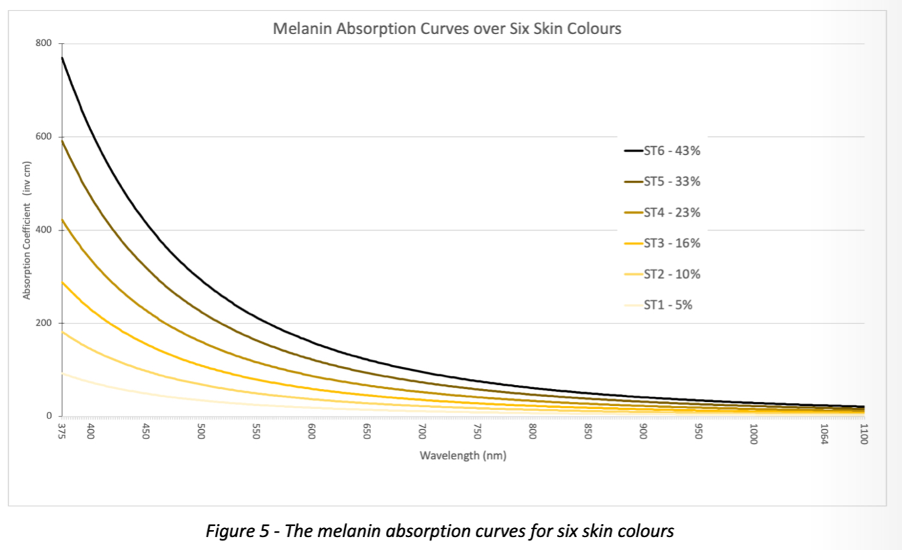
Taken from my book – ‘Chapter 3 – Fundamentals of Laser/IPL Hair Removal’
In a nutshell, darker skin tones ‘steal’ more fluence than lighter tones. So, we need to increase the fluence to account for this, which, in turn, increases the amount which will be ‘stolen’ in the epidermis, and hence, higher temperatures there!!!
How do we resolve this conundrum?
I look at it like this:
Set the fluence according to the target – NOT the skin tone. Deeper targets require higher fluences to ensure success.
Set the skin cooling according to the skin tone.
Darker skin tones require more cooling, to minimise unwanted damage – apply ice-packs for a longer time, for darker skin tones. For ‘dark’ skins, I’d use ice-packs for up to 5 minutes before firing any laser/light energy at them.
In essence, you can apply skin cooling for quite long times before starting treatment. This will not have a negative impact on the treatments, if applied correctly. You CANNOT overcool hair follicles.
If treating blood vessels, cool as above, remove the ice-packs, then wait for about 10 seconds, or so, before applying the energy. In that time, fresh, warm blood will replace the cooled blood in the target vessels.
Conclusion
Turning down the fluence for dark skins is absolutely the wrong thing to do – yet this is a common mistake out there. The fluence should be chosen according to the target, not the skin tone. Cooling times are chosen according to the skin tone.
In summary, cooling is critical for good results!
Hope this helps,
Mike.


 Mike Murphy's Blog