
I have seen many reports, though the years, from laser/IPL hair removal techs asking why they see ‘all the hair growing back’ usually after four, five or six sessions. This keeps cropping up, again and again.
I was puzzled by this phenomenon so I thought about whether my hair growth model might be able to answer it.
Back in 2020, I had a bit of time to do things like write my books and build new computer models (plus learn the Tango!). One model looked at the hair growth cycles across the body. I wanted to find the optimum time between laser/IPL sessions – a question I was often asked.
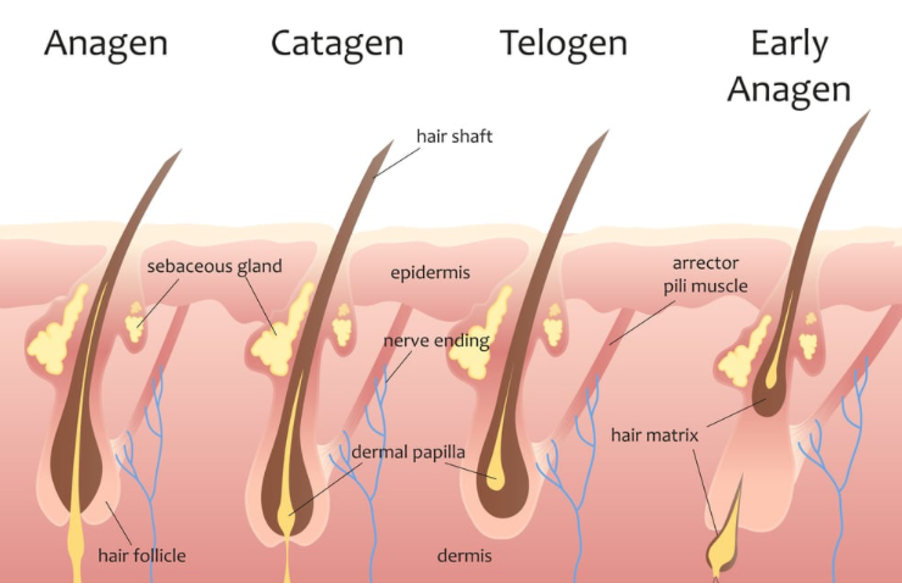
I took the growth timings data from the famous Richards and Merhag study and plugged them into my model. I then ‘killed’ a percentage of anagen hair follicles and found that it was quite easy to see how things developed during treatment sessions.
My final answer was simple – leaving longer gaps between sessions will yield ‘better’ results.
However, my original model was flawed. I recently learned that laser/IPL treatments only really ‘kill’ follicles when they are in the ‘early anagen’ stage. At that point the bulb and dermal papilla are just beneath the stem cell bulge, located where the arrector pili muscle attaches to the follicle. Typically, this is only about 1.5mm deep, for all follicles across the body.
When the hair moves out of ‘early’ anagen, the bulb descends towards the deeper dermis and sub-cutis layer. As it does so, it takes a portion of stem/germ cells with it – making them more difficult to denature with light and heat energy.
Once the follicle is in late anagen, they become very difficult to kill, simply because many of the target cells are too deep to effectively heat.
This is the explanation behind my ‘kill-stun-null’ thinking – every time we treat hair follicles, we kill some, stun others and leave the deepest ones unaffected (null). I blogged this recently – https://mikemurphyblog.com/2024/04/03/the-kill-stun-null-zones-in-laser-ipl-hair-removal-why-some-treatments-dont-work/. This is just inevitable.
So, I adapted my hair growth model to only ‘kill’ the ‘early’ anagen hairs. Some of the other anagen hairs were then ‘forced’ into catagen, whilst the others were left as they were (unaffected or ‘null’).
This changed everything!!
I realised that after a few sessions, many of the follicles were now in either anagen or catagen – many more than with the older model.
Then I saw something very strange and interesting – after about five or six sessions (depending on the gap between sessions) most of the follicles were in the same growth phase. At the time of the subsequent treatment session, most had gone into anagen – “synchronised growth”.
It seems that when we stun the follicles over and over again, they eventually tend to growth back at the same time. When your client comes back complaining about ‘all my hair has come back’, they are right – sort of!
In fact, they are not right at all!! What they are actually seeing is a whole bunch of follicles growing at the same time – just not the same follicles as were present at the start of the treatment. These are the follicles which survived previous treatments, and are now all growing simultaneously. Previously they would have been growing at random times.
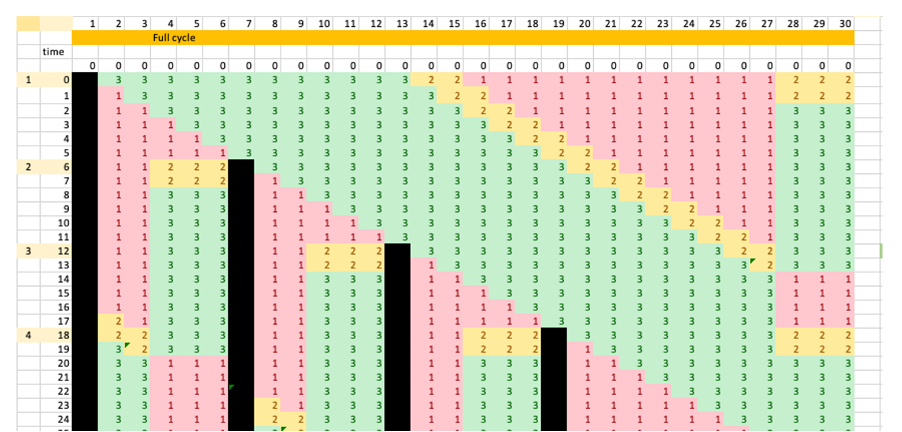
My model – black indicates fully denatured (dead) follicles. Pink is anagen, yellow is catagen and green is telogen.
The simultaneous growth makes it appear as if they have ‘all come back’!
The good news is that when they are all growing like this, it is a good time to zap them with the laser/IPL.
BUT…..
You need to treat them as soon as they appear. The duration of early anagen is not long – perhaps 7 to 10 days (I’m trying to get a definitive answer on that from the research!). If you don’t hit them soon, they will all move out of early anagen, making it more difficult to kill them.
Summary
Synchronised growth is not a bad thing. It’s an indicator that those follicles are now all growing at the same time. If caught early enough, you will get a good result when you treat them.
We just need to educate the clients about this…
I’m planning to write a paper on this for publication soon.
Hope this helps,
Mike.

PS Our next MasterClass wil be in London on November 3rd and 4th. If you’d like to come along, please write to Lisa at DermaLaseMasterClass@gmail.com.


 Mike Murphy's Blog