
Human hair grows according to a cycle. This cycle can be broken down into three main phases – anagen, catagen and telogen. To understand this process, we need to look closely at the follicles, and their structure.

All follicles are comprised of two distinct parts – the upper, permanent part which includes the stem cell bulge, the arrector pili muscle and the sebaceous gland. This part of the follicle is always around whilst the lower part is not!
The deeper region of the follicle is the ‘cycling’ region – this is the part of the follicle which grows towards the sub-cutis (fatty tissue layer) and then regresses back towards the surface, after a period of time.
The duration of the anagen and telogen phases are variable across the body while the catagen phase is typically around two to three weeks in duration.
The precise details of the initiation of the anagen phase are not fully understood as yet, but it is believed that external signals trigger the growth stage. Anagen I lasts for a relatively short time – perhaps only up to 48 hours.
Anagen Hair
| Anagen I – The ‘germ’ undergoes a burst of mitotic activity. Initiation of anagen growth – melanogenesis begins. Bulge stem cells proliferate rapidly. |
There follows a short and rapid period when the dermal papilla and secondary germ start to grow towards the sub-cutis layer at a rate of around 0.25 mm per day.
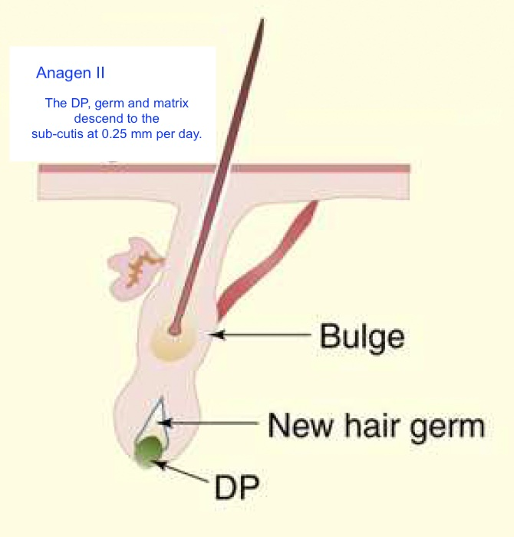
| Anagen II – A brief period when the germ grows down around the DP and the first keratinisation, the internal sheath, begins. DP and germ begin to descend at around 0.25mm per day. |
The dermal papilla (DP) is often described as the ‘engine room’ of follicle growth. It appears that destruction of the DP (and possibly the germ) is required to kill a follicle, along with the stem cells in the bulge (these are the source of the new cells required by the growing follicle).
Most of the growth of the follicle occurs during anagen III including the hair shaft. It not only grows downwards, but also in diameter. Melanosomes begin to populate the hair shaft giving it its colour. During this stage the hair shaft begins to grow towards the skin surface at a rate of around 0.35 mm per day. However, it does not penetrate through the epidermis until anagen V.
The duration of anagen III is determined by the thickness of the dermis in that region. Some areas, such as the bikini and axillae (underarms) may be 5mm deep. Hence the anagen III stage may be up to two weeks in length in such areas.

| Anagen III – The follicle attains its maximum length – about 3 times that of the telogen size. The bulb is now completely formed (the bulb is mainly responsible for the hair shaft growth) and the DP cavity is constricted at its base. The melanocytes become aligned along the DP and new melanin granules start to be produced. The base is located in the sub-cutis at the end of this phase. Growth and pigmentation of the HS begins. Blood vessels begin to connect to the bulb. |
Older telogen hairs may still occupy the upper follicle. They can remain there until they shed. In some follicles, they may not shed and the telogen hair can remain alongside the new anagen hair, for some time.
During anagen IV and V, the various parts of the follicle continue to grow. In anagen V the tip of the hair shaft finally emerges through the epidermis and becomes visible.
| Anagen IV – In the upper bulb, a cone which will become the cortex and medulla of the hair shaft contains pigment granules. Growth and pigmentation of the HS continues. |
| Anagen V – The tip of the hair shaft has broken through the top of the internal sheath, which is about the level of the epidermis. It is now just visible. Follicle fully formed by the end of phase 5. |
The follicle is now fully formed and rooted in the sub-cutis with a blood supply.
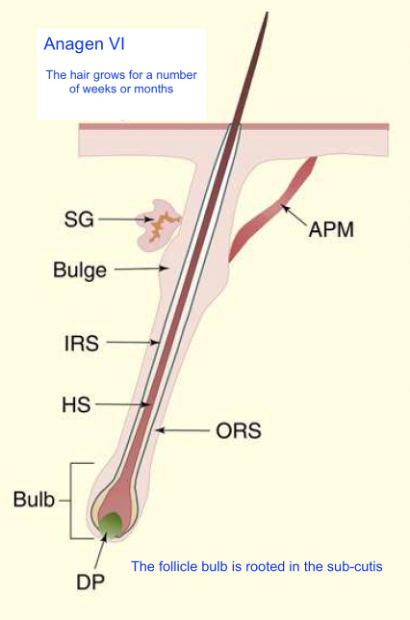
| Anagen VI – HS emerges through epidermis and continues to grow for the duration of anagen. |
During anagen VI the hair shaft continues to grow. This stage may last from weeks to months, or even years in the scalp. The length of any hair is determined by this growth stage.
At some point, new signals trigger the next stage – catagen.
Catagen Hair
During catagen, apoptosis occurs – many of the cells die. As they do, the follicle regresses back towards the skin surface. An ‘epithelial column’ remains behind, where the bulb used to be. The DP is now detached from the hair shaft and is usually located at the end of this column, but it also regresses vertically. However, if the DP cannot reach the base of the follicle at the end of this phase, then that follicle will not regrow in future.

The follicle loses its blood supply and, hence, source of nutrients. Typically, the catagen phase lasts between two and three weeks. During this stage, a club hair forms – this is a hair which is no longer growing but is firmly stuck in the follicle. However, a catagen hair may appear to be growing, simply because the entire follicle is moving towards the skin surface.
Once the regression phase has ceased, the follicle returns to the telogen phase.
Telogen Hair
The telogen phase is often referred to as the ‘resting’ phase. This typically lasts for around two to four months in most body areas. Some scientists think that the follicle is not merely ‘resting’ at this time. They believe that other activities may be underway, which actively lead to the next anagen phase. This is still being researched.

There is a fourth phase – exogen. During this period the hairs shed – either by being ‘pushed’ out by new, growing hair, or by physical friction on the skin surface. The anagen phase can coincide with the exogen phase, for a significant time.
Summary
The above is a brief description of the growth phases of human hair. However, there are still some unanswered questions regarding the ‘triggers’ at various points in the cycle. Other questions arise around why some follicles may remain dormant for many years before hormonal changes initiate anagen growth in them. Likewise, the duration of anagen can change with age – some men clearly exhibit excess growth of eyebrow hair in later life, alongside new growth in previously bald areas (ears and nose etc!!) This can also occur in some women too.
Hope this helps,
Mike.

References
Al-Nuaimi et.al. A prototypic mathematical model of the human hair cycle. Journal of Theoretical Biology, 310 (2012) 143-159.
BOUABBACHE Stéphanie, POURADIER Florence, PANHARD Ségolène, CHAFFIOTTE Cécile, LOUSSOUARN Geneviève. ‘Exploring some characteristics (density, anagen ratio, growth rate) of human body- hairs. Variations with skin sites, gender and ethnics.’ International Journal of Cosmetic Science. Vol. 41, Issue 1. Feb. 2019. Pp46-54.
Chase, H. ‘Growth of the Hair.’ Physiological Reviews, Vol. 34, Issue 1, Jan 1954. pp113-126.
Ross EV, Ladin Z, Kreindel M, Dierickx C. ‘Theoretical Consideration in Laser Hair Removal.’ Dermatologic Clinics, Vol. 17, No.2, April 1999.


 Mike Murphy's Blog
For male beard hair, people often get no results from HUD IPLs. are the bulbs too deep even in stage 2-3 anagen?
I don’t think so! I suspect male beard hair needs more frequent treatments – every two or three days!