

As many of you know, I like to build and develop computer models investigating how light energy interacts with skin constituents etc. I’ve been doing this since 1987 and am now beginning to get the hang of it!!
One model I built, a few years ago, looked at the hair growth cycles across the body. With that model I was able to determine that leaving longer intervals between treatment sessions was probably the most optimum way to treat hair. By adopting this approach you maximise the number of anagen hair follicles for treatment in each session.
Recently, I have been looking at the application of home use devices (HUDs) for hair removal. I know many people write these off as ‘useless’, but the evidence is clear that they can work, and pretty well too – if used correctly!
But the protocol required is quite different to that used with professional, clinic-based systems.
Why?
Well, it comes down to three things – the fluence, the follicle bulb depth and the frequency of application (how often it must be applied).
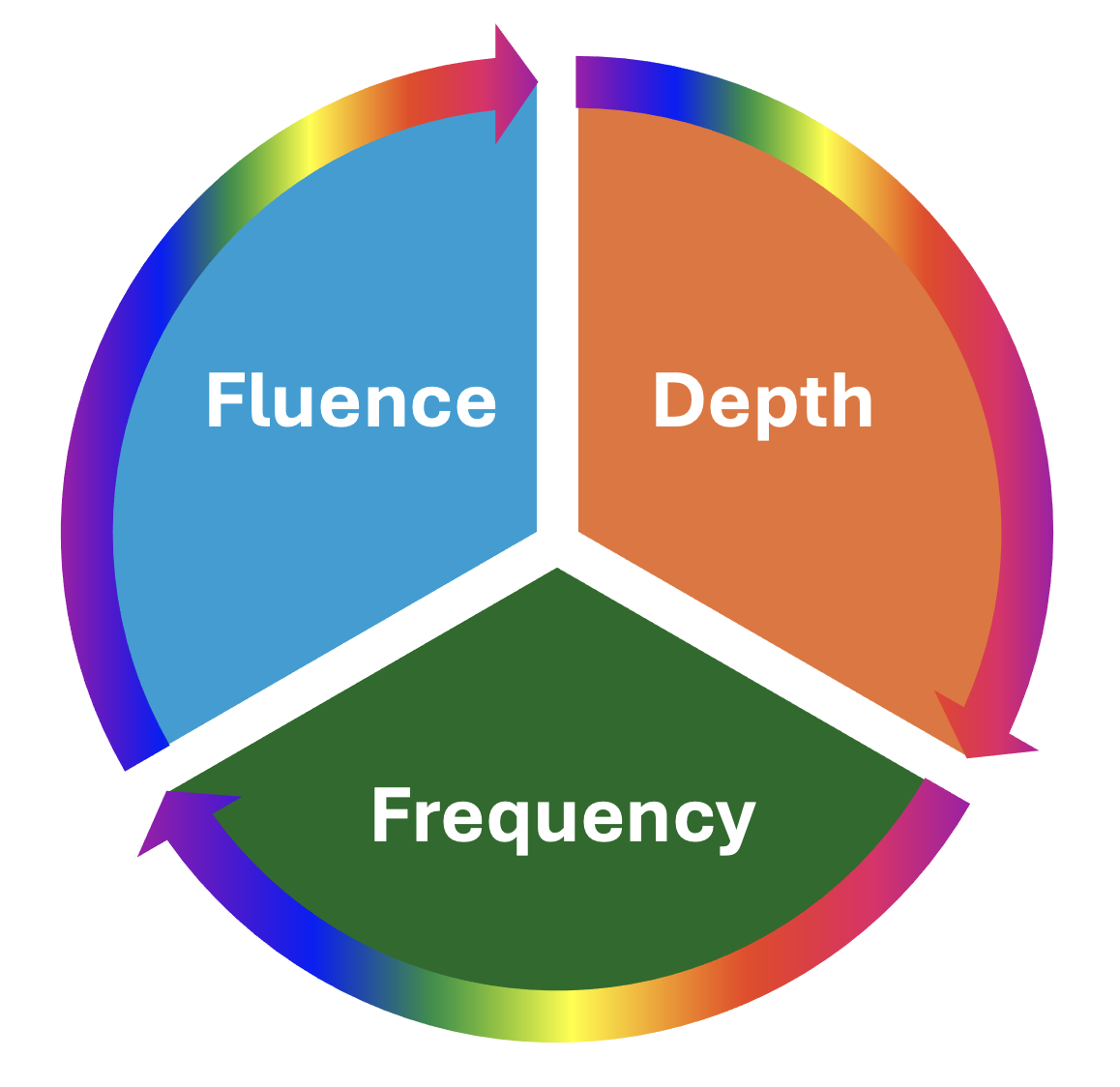
- Fluence
The fluence (concentration of energy) determines the rise in temperature in the hair follicle, in those locations where the light is absorbed – i.e. the melanin. If this temperature rise is sufficiently high, then the likelihood that the follicle is irreversibly denatured (cooked) is also high. Higher fluence leads to higher success rates.
2. Depth
However, the effective depth at which we can guarantee follicular death depends greatly on the fluence. Higher fluences can target deeper follicles, particularly the dermal papilla which needs to be sufficiently damaged to ensure follicle death. The stem cell bulge is always at a depth of around 1.5mm, so it is relatively easy to target. However, the hair matrix, secondary germ and dermal papilla all descend towards the sub-cutis (fatty layer) soon after the anagen phase has been triggered, at a rate of around 0.25 mm per day.
This means that these targets become increasingly difficult to denature properly with time. Higher fluences will kill deeper targets, but there is a limit with all current technologies. At some depth, the targets are simply too deep to kill, with the fluences available to us.
The problem with most HUDs is that their fluence is relatively low compared with clinic-based devices. So, they can only successfully target the most superficial follicles, when they are still in the early anagen stages.
3. Frequency
And this is where the frequency of application comes in. Human hair grows asynchronously – unlike most mammals where the hair grows simultaneously. That’s why they have ‘fur’ and we have ‘hair’.
This mean that our follicles can grow at apparently random times. So, we can never know when the follicles are in early anagen, or any other time! The only times we can be certain is when the hair is visible – those hairs must be in anagen 6 (when the hairs continuously grow for some weeks or months), or in catagen or telogen.
The hairs which are at the ‘best’ time to target are in the early anagen stages – 2 to 3. During these stages the hair shaft is growing and acquiring melanin, but the bulb has not yet reached the sub-cutis until the end of anagen 3.
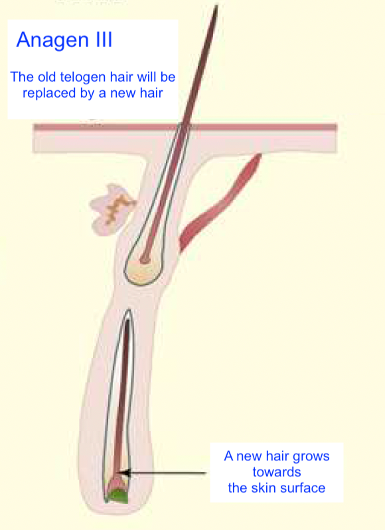
To ensure the best outcome with HUDs, we need to apply them very regularly – every few days – to be sure of hitting as many early anagen (stages 2 and 3) follicles as possible.
Once the follicles descend beyond a certain depth, the fluence in those devices will be insufficient to effectively kill the follicles.
Due to the nature of hair growth in humans, new early anagen follicles are coming in to existence nearly all the time! A high frequency of application will be able to target many of those follicles.
When high-fluence, professional systems are applied the frequency is much lower since they can kill many more anagen follicles in each session, to a much deeper level.
Summary
So, there is a link between fluence, depth and frequency – the “hairy trinity” as I like to call it! The higher the fluence, the deeper the effectiveness and the lower the required frequency of treatments. And the opposite is true too, for HUDs.
One of the most interesting results of this analysis is that the follicles we are trying to kill are completely invisible to us. Their hair shafts have not yet pierced through the epidermis – they are completely within the dermis. The hairs only begin to appear visible in anagen 5.
All the hairs we can see are either in anagen 5 or 6, which are too deep to kill, or in catagen or telogen – which we cannot kill with light energy.
This begs the questions – should we simply wax all those hairs we can see since they cannot be effectively killed using light energy? I am not sure about this yet – there may be an advantage in heating them too.
However, there is a clear advantage in waxing them all out prior to laser/IPL treatments – the amount of plume in the air would be significantly reduced. This is definitely a good thing for all laser/IPL operators!!
I will be looking into this stuff more in the future…
Hope this helps,
Mike.


 Mike Murphy's Blog
Mike, does this hold true to Diod as well? I have a unit ( the Alpha) that has both hand pieces, IPL & Diod. My training from the company suggests 1-2 mm of growth as said to have the laser pick up the melanin in the hair therefore the laser will travel to the shaft much more effectively. Training wants us to piddle around with the timing between sessions but still hard for me to grasp proper timing etc. I know each case will be different, but what are your thoughts on the average as a whole?
Hi Donna,
The fact is, we cannot actually see the hairs we are killing – they have not penetrated through the epidermis. Any hair which is visible is alreayd too deep for most devices to reach! So, hair growth above the skin surface is entirely irrlevant.
As for timings, my research shows, that the timings depend on the fluence and the depth of the follicles – as dicussed on my post. With slaon-based systems, I usually recommend leaving longer gaps between sessions, to ensure more follicles are in the ‘correct’ stage of growth.
if depth is the issue, wouldn’t a high Fluence NDYAG laser be able to destroy all follicled, regardless of depth? Because of its longer wavelength
Yes, but only if it delivered enough fluence.
Hi Donna,
There is no evidence that the laser energy “travels down the hair shaft”. Some heat might, but not enough to make much difference.
Regarding timing, I think the longer we leave, the better, in most cases. With more time between sesions, more follicles will be in the correct anagen phase each time.