
I recently came across an excellent book called “PMUni Colourant Manual” by Jasmine Diebelius which delves into the world of PMU inks and their constituents.
In it, she indicates the pigments used to formulate many commonly-used PMU inks. This has proved very interesting to me, because of the ramifications for laser removal.
In one section, Jasmine displays 42 coloured pigments with their corresponding levels of iron oxide, zinc, chromium oxide and titanium dioxide. It also shows which ones are considered to be ‘difficult’ to remove by laser!
She indicates that 12 out of the 42 are difficult to remove via laser – mostly yellow pigments (not surprisingly), and white pigments.
She also discusses the various chemical constituents of some of these inks – organic and inorganic (mineral and synthetic).
It is a very informative book and I would recommend it to anyone involved in PMU.
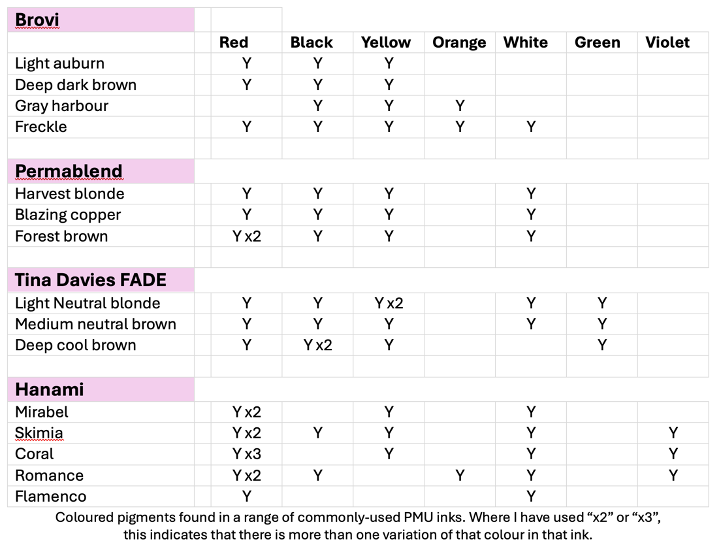
It also reveals some interesting issues when considering laser removal of these inks. As we can see in the table above, most of these inks contain a number of pigments. In particular, yellow and red are found in almost all of them. This explains why many people see a yellow or red/pink residue after a number of laser sessions on PMU eyebrows.
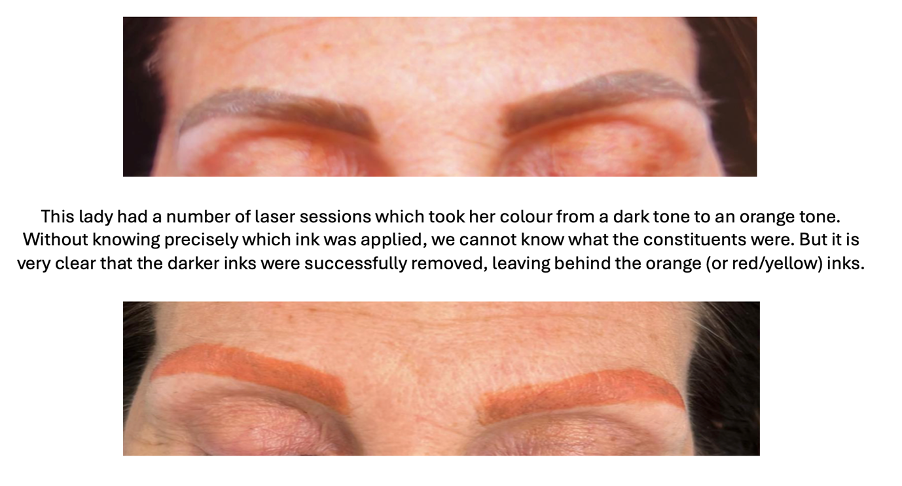
The darker pigment colours are easily removed by the laser treatments, leaving behind the reds, yellows and oranges. These colours can be more difficult to remove with the different wavelengths available. Yellow, in particular, is a difficult colour to remove because it does not absorb any of today’s laser wavelengths strongly.
As I have discussed before (click here), these colours can be removed, but they require higher fluences than normally applied with modern-day lasers. Consequently, in many cases the residual colours are left behind, sometimes requiring other treatment methods.
Conclusion
As with body tattoos, we can never truly know which pigments are contained within the inks we treat with lasers. But we do know that the darker inks will always react more readily than the lighter coloured inks. They will clear much more quickly than the lighter colours – potentially leaving previously unseen colours behind!
We may be able to remove these lighter inks by using alternative wavelengths and higher fluences. But it’s not always a good idea due to the higher risk of skin damage.
Hope this helps,
Mike.



 Mike Murphy's Blog