
Someone recently asked me ‘which is the most aggressive wavelength for the skin?’
That’s interesting question…
We should first start by identifying which wavelengths we need to consider. In many skin treatments we use visible and near-infrared light – from around 400 nm up to 1064 nm (Nd:YAG) or even 2940 nm (erbium:YAG).

CO2 lasers are a different kettle of fish since they cannot be regarded as ‘near’ infrared – they are definitely far-ish infrared at 10,600 nm.
So, if we confine this discussion to the near IR light, then we can say the following:
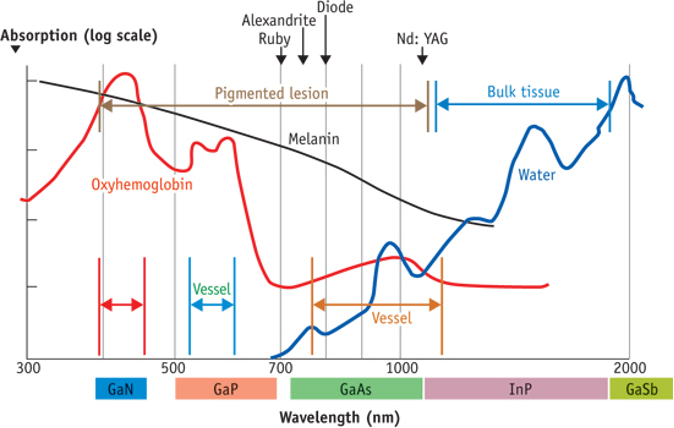
The absorption curves for the three main absorbing chromophores in the skin – melanin, blood and water
| 532 nm (Nd:YAG frequency doubled) | This is a green light and used to typically treat tattoos and pigmentation (in nano/picosecond mode). It is very strongly absorbed by melanin and blood, and so, is quite aggressive in skin. It can easily cause ‘damage’, especially with nanosecond and picosecond pulsewidths. |
| 585/595 nm | These are typical dye laser outputs and used to target blood vessels. They are also well absorbed by melanin and blood, and can cause hyper- and hypo-pigmentation and purpura. |
| 694 nm | This is the ruby wavelength. We used this wavelength, back in the early 1980s, to show that tattoos could be removed safely. It is not well absorbed by blood but still quite strongly absorbed in melanin – and so, it can induce hypo- and hyper-pigmentation. |
| 755 nm | This is the alexandrite wavelength and is used for tattoo removal (QS and pico lasers) and for hair removal (millisecond lasers). It is also quite well absorbed by melanin and so is typically not used on darker skin tones, as it can induce pigmentary changes. |
| 1064 nm | This is the Nd:YAG fundamental wavelength and used to treat tattoos and hair & vessels (nano/picoseconds and milliseconds, respectively). It is probably the most ‘benign’ of these wavelength as it is poorly absorbed by both melanin and blood (and tissue water, even though it encroaches into the water absorption curve). In essence, this is a very ‘gentle’ wavelength as it requires high fluences (in the millisecond regime) to induce the desired absorption in hair and blood. |
| 2940 nm | This is the erbium:YAG wavelength and is used for superficial resurfacing and rejuvenation. It is quite a gentle wavelength too, but can induce some hyper-pigmentation in some cases. |
So, as we can above, the shorter visible wavelengths are quite aggressive on the skin due to the high absorption of light energy by melanin and blood. As the wavelengths become longer, they are absorbed less and less by these chromophores, resulting in less damage in the skin.
This means that we must be careful of which wavelength we choose to use. For example, in tattoo removal, many people will drop from the 1064 nm wavelength down to 532 nm to target certain coloured inks. This is a good idea, in many cases, since the ink colour will absorb the 532 nm more strongly than the 1064 nm. But, so will the skin!
As a direct consequence of this choice, the skin is much more likely to suffer damage, even when using the same fluence, spot size etc, as with the 1064 nm – simply because of the change of wavelength.
More care – during and after the treatments – must be taken, therefore, to minimise any unwanted damage.
Be careful out there…
Hope this helps,
Mike.


 Mike Murphy's Blog