
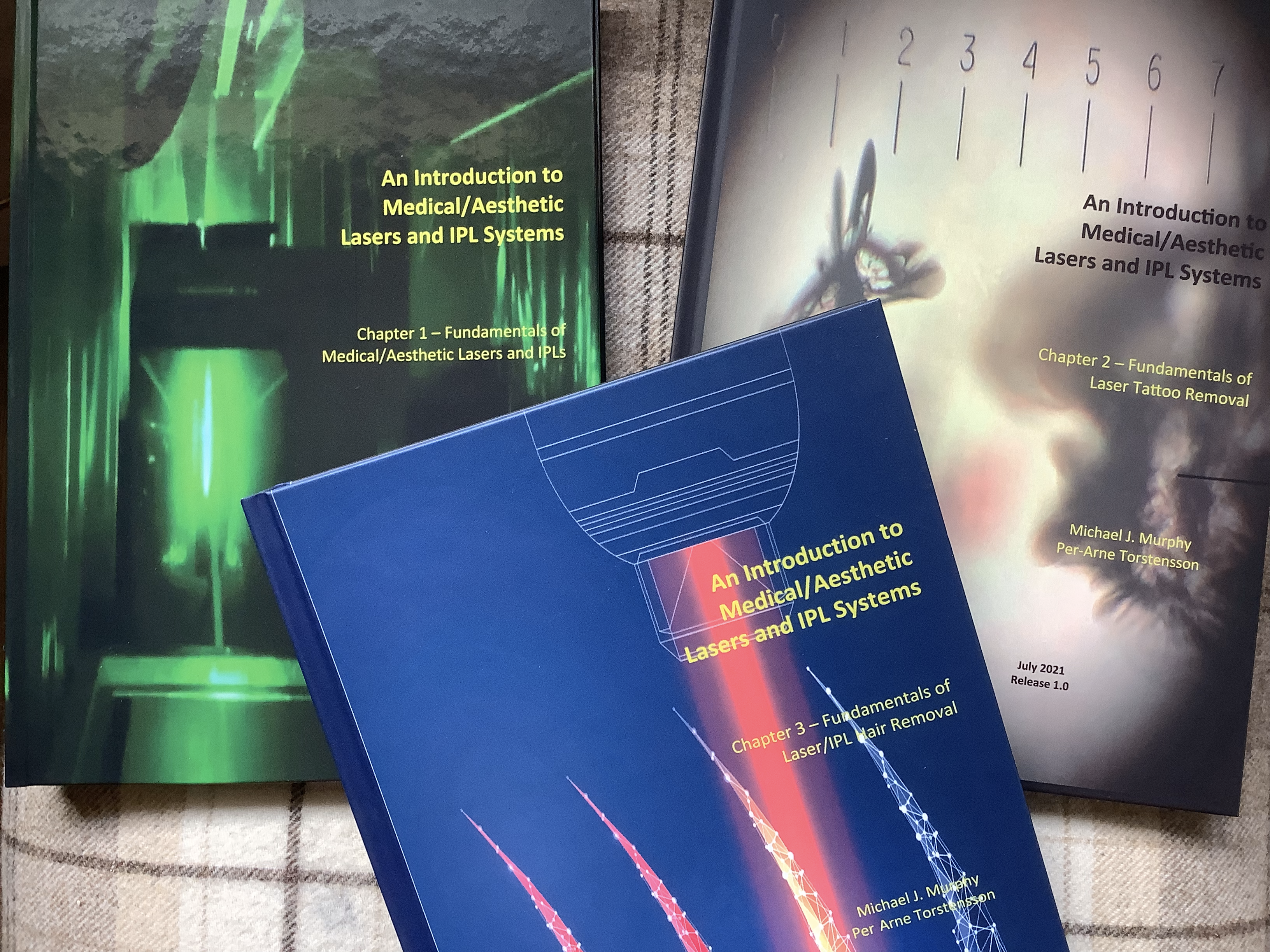
I asked an AI for a summary of each of my three books.In particular, I asked for the salient points:
Three Key Points:
Based on the detailed content provided from “An Introduction to Medical/Aesthetic Lasers and IPL Systems” by Michael J. Murphy and Per-Arne Torstensson, here are three core points with their supporting arguments:
—
1. Understanding Laser/IPL Fundamentals Is Crucial for Safe and Effective Treatments
Many laser/IPL users, even experienced ones, lack a deep understanding of the fundamental principles behind the technology. The authors estimate only about 20% truly understand how to select correct parameters and why. Without this knowledge, users risk poor clinical outcomes, unwanted tissue damage, and patient dissatisfaction. The book emphasizes learning core concepts such as wavelength, energy density (fluence), pulse duration, power density, and light-tissue interactions, because these determine how the light energy affects skin tissues safely and effectively. Proper understanding helps practitioners choose the right equipment and parameters, apply treatments safely, and optimize results.
—
2. Proper Selection, Calibration and Skin Cooling Are Key to Achieving Desired Clinical Outcomes
The choice of equipment and its calibration critically impact treatment success. Many users rely on preset parameters without calibration, leading to underpowered treatments and poor results. The authors stress “No calibration, no sale!” because laser/IPL outputs degrade over time, and without calibration the actual fluence and power density delivered to the skin are unknown. Furthermore, skin cooling is absolutely critical since >90% of the applied energy often heats non-target dermal tissue, risking damage. Good cooling systems reduce unwanted heating and allow safer use of higher fluences and longer pulses. The authors describe differences between professional IPL systems with advanced cooling and cheaper salon models which often lack effective cooling, increasing the risk of burns.
—
3. Laser and IPL Safety Must Be Strictly Observed, Including Understanding Classification, Eye Protection, and Room Controls
Both lasers and IPLs can be hazardous, particularly to the eyes and skin, if not handled properly. The text details international laser classifications from Class 1 (lowest hazard) to Class 4 (highest hazard), explaining that most medical/aesthetic lasers are Class 3B or 4, requiring stringent safety measures. The importance of using appropriate laser safety eyewear with correct optical density for the wavelength and power is emphasized, along with understanding maximum permissible exposure (MPE) and accessible emission levels (AEL). The nominal ocular hazard distance (NOHD) defines safe distances from laser apertures. Clinics must have designated laser rooms, strict local rules, and proper training to ensure operator and patient safety. The authors also highlight emerging concerns such as toxic plume exposure and recommend protective measures.
—
These core points encapsulate the foundational knowledge, practical usage, and safety considerations essential for anyone working with medical or aesthetic lasers and IPL systems, as comprehensively covered in the text.

You can find a free, online version here – https://online.flipbuilder.com/rbhw/bwhw/
Five Key Points
Based on the detailed content provided from “Chapter 2 – Fundamentals of Laser Tattoo Removal,” here are five critical insights that capture the essence and depth of the material:
- Complexity and Variability of Tattoos and Their Removal:
Tattoos are highly variable in composition, depth, and colour because inks are often mixtures of multiple pigments, sometimes including heavy metals and reflective compounds like titanium dioxide. This variability makes laser tattoo removal complex and unpredictable, as the absorption of laser energy depends heavily on ink constituents and depth. The body’s response, including macrophage activity and scar tissue formation, further complicates treatment outcomes, meaning no two tattoos respond identically to laser removal.
- Fundamental Physics and Biology Behind Laser Tattoo Removal:
Laser tattoo removal operates primarily via a photomechanical (photoacoustic) reaction where very short pulses of laser light (nanoseconds to picoseconds) cause rapid heating and fragmentation of tattoo ink particles within fibroblasts and macrophages in the dermis. The laser energy is absorbed selectively by tattoo pigments, generating explosive mechanical forces that break ink aggregates apart, allowing gradual clearance by the immune system. However, some thermal conduction and collateral tissue damage cause micro-scarring, which accumulates with each treatment and reduces laser efficacy over time.
- Critical Laser Parameters Affecting Treatment Efficacy and Safety:
The choice of laser wavelength, pulsewidth, fluence (energy density), spot size, and repetition rate profoundly influences treatment success and patient safety. Longer wavelengths (e.g., 1064 nm Nd:YAG) penetrate deeper and are less absorbed by epidermal melanin, making them safer for darker skin and deeper inks. Shorter wavelengths (e.g., 532 nm) are absorbed more superficially and can cause more epidermal damage and blistering. Pulse duration affects peak temperatures on ink particles, with picosecond lasers generating higher peak temperatures at lower fluences compared to nanosecond Q-switched lasers. Spot size affects penetration depth—larger spots penetrate deeper due to reduced scattering. Proper calibration and understanding of power density are essential to avoid overtreatment and scarring.
- Treatment Protocols and Patient Management Are Key to Optimal Outcomes:
An ideal approach involves starting with low fluences, slowly increasing energy in small increments while observing for subtle skin reactions like erythema and oedema rather than chasing visible frosting or audible cracking sounds, which often indicate overtreatment. Cooling before and after treatment, spacing sessions adequately (potentially 12 weeks or longer rather than the traditional 6-8 weeks), and careful patient aftercare (e.g., avoiding sun exposure, infection prevention) help minimize adverse effects such as blistering, hyper-/hypopigmentation, and scarring. Test patches are used mainly to assess skin reaction rather than treatment efficacy. Patient factors like skin type, health, smoking, and lymphatic drainage also influence clearance rates.
- Technological Advances and Realistic Expectations:
Picosecond lasers represent an advancement over nanosecond Q-switched lasers by delivering shorter pulses with higher peak power, potentially improving clearance rates and reducing side effects, but clinical evidence shows only modest superiority and at much higher cost. Marketing claims of “removing all colours” or “superior wavelengths” should be viewed sceptically, as no laser wavelength guarantees complete removal of all tattoo colours due to the complex ink chemistry. Furthermore, some tattoos, especially those with deep or reflective pigments, may never be fully removable with current laser technology. Operators must understand these limitations, educate patients accordingly, and avoid unproven methods such as IPL for tattoo removal, which are ineffective and unsafe.
—
Summary:
This chapter emphasizes that laser tattoo removal is a scientifically complex procedure requiring deep understanding of laser physics, skin biology, ink chemistry, and patient-specific factors. Success hinges on selecting appropriate laser parameters, careful calibration, patient management, and realistic expectations. Advances like picosecond lasers offer improvements but do not guarantee complete removal. Safety, especially eye protection and avoiding overtreatment, is paramount. The chapter also highlights the necessity of ongoing education and critical evaluation of claims to ensure optimal clinical outcomes.
Free, online version – https://online.flipbuilder.com/rbhw/hcmt/
Five Key Points:
Based on the comprehensive content provided from “Chapter 3 – Fundamentals of Laser/IPL Hair Removal (Edition 2),” here are 5 key points extracted and explained in depth:
1. Fluence is the Most Critical Parameter for Effective Hair Removal
Fluence, or energy density (measured in J/cm²), dictates the success of laser/IPL hair removal treatments. Adequate fluence must be applied to raise the temperature of the target stem cells in hair follicles sufficiently to cause irreversible denaturation (cell death). Insufficient fluence is the leading cause of poor treatment outcomes, with lighter or finer hairs often resulting from under-dosing. The fluence required varies depending on body site and follicle depth, with deeper follicles (e.g., underarms, bikini) requiring higher fluences. Proper fluence selection balanced with skin cooling is essential to maximize efficacy while minimizing damage.
2. Proper Skin Cooling is Essential to Minimize Pain and Prevent Epidermal Damage
Cooling the epidermis before, during, and after laser/IPL exposure is critical to protect the skin and reduce patient discomfort. Cooling lowers the temperature of thermal pain receptors located just below the epidermal basal layer, increasing the temperature threshold for pain and allowing higher fluences to be safely applied. Ice packs are the most effective cooling method, providing deeper and sustained cooling compared to air or cryogenic sprays. Without sufficient cooling, patients experience more pain, and risks of blistering, hyper/hypopigmentation, and scarring increase.
3. Hair Growth Cycle and Treatment Timing Influence Treatment Success
Hair follicles cycle through anagen (growth), catagen (regression), telogen (resting), and exogen (shedding) phases. Laser/IPL treatments are effective primarily during the anagen phase when stem cells are active and melanin concentration is optimal. Approximately 50-60% of hairs are in anagen at any time, necessitating multiple treatment sessions. Intervals between sessions should allow follicles to re-enter anagen for maximal efficacy; typically 6 to 8 weeks or longer depending on the body site. Treating too early or too frequently reduces efficiency, increasing total sessions required.
4. Laser and IPL Technologies Differ but Can Achieve Equivalent Outcomes if Used Correctly
Lasers emit a single, coherent, monochromatic wavelength of light, while IPL devices emit broad-spectrum, incoherent light filtered to desired ranges. Although different in design and light quality, both can effectively target melanin in hair follicles. The choice of wavelength affects penetration depth and absorption; for example, Alexandrite lasers (755 nm) are strongly absorbed but risk epidermal damage in darker skin, while Nd:YAG lasers (1064 nm) penetrate deeper with less epidermal absorption, making them safer for darker skin tones. IPLs’ broad spectral output allows targeting multiple chromophores but requires careful filter selection and parameter adjustment.
5. Pulsewidth Has Much Less Impact on Treatment Outcome Than Fluence
Contrary to some beliefs, pulse duration (pulsewidth) plays a less critical role than fluence in achieving follicle destruction. While the pulsewidth affects the peak temperature in the hair shaft, the key target is the stem cells in the follicle bulge and bulb, which are heated indirectly by conduction from the hair shaft. Computer models show that these stem cells reach peak temperature after the pulse ends, and their temperature-time history—which determines cell death—is mostly independent of pulsewidth, provided it is within a reasonable range (roughly 1–100 ms). Higher fluences reduce the importance of pulsewidth further.
***************
These key points encapsulate the fundamental scientific and practical insights necessary for effective and safe laser/IPL hair removal, highlighting the critical roles of fluence, skin cooling, treatment timing, understanding of hair cycling, and technology differences.
Free , online version – https://online.flipbuilder.com/rbhw/tlkc/mobile/index.html
Hope this helps,
Mike.



 Mike Murphy's Blog