
A laser colleague of mine sent me a lovely wee gift – the “Neatcell” pen (thanks Neil!).
The company’s web site is here (it’s full of contradictions and discrepancies!!). They claim that this device is a “picosecond laser”. I’m not so sure…
Firstly, picosecond lasers are not simple devices. They use a technique called ‘mode-locking’ to generate such short pulses (less than 1 nanosecond). I have no idea how this could be put inside a ‘pen’.
Secondly, I am not aware of any picosecond diode laser device in existence. I’m no expert, but I am pretty sure diode lasers cannot be made to work in a picosecond mode, with any discernible output.
Thirdly, this unit is either an LED or a laser diode – it’s hard to tell. But the power output is something like 1 Watt, or thereabouts.
They have two devices – the ‘red’ pen and the ‘blue’ pen. I couldn’t find any details about the wavelengths, the pulsewidths or the available fluences.
They say that the blue pen requires the operator to wear safety glasses, although none are provided. They also claim that the red pen does not need the operator to wear any safety glasses – if it truly is a laser, then they are wrong!
So, what sort of results can it generate?
I had a look at their web site and didn’t find much. They do show some clinical results, but I doubt they were generated with their device!
They also show an excellent study carried out which compared proper picosecond lasers with a nanosecond laser. But again, this was not done with their device!!
One video I found on YouTube from a chap who is detailing his progress:
We can clearly see tissue damage after each session – both physical disruption and scar tissue formation. He compares his progress with someone who is undergoing a proper laser treatment. The difference is quite marked – the laser treatment does not induce anything like the damage his Neatcell is.
After 13 sessions his tattoo now looks like:
His results appear to show some ink clearance, but also quite a lot of tissue damage. He refers to the “temporary scarring” – I’m not so sure that it will be ‘temporary’.
This young lady made a video of her applying this device to her own tattoo –
In it, we can see a fair amount of smoke rising from her skin. I’m not sure if this is just hair vapourising, or her epidermis…
My tests
I wanted to test this device on some dark ink. So, I acquired a four-pack of Guinness (always a good target) and fired some shots at it. I set the device up for ‘full’ power (whatever that is!!) and 5Hz, and fired it at the black and red ink.
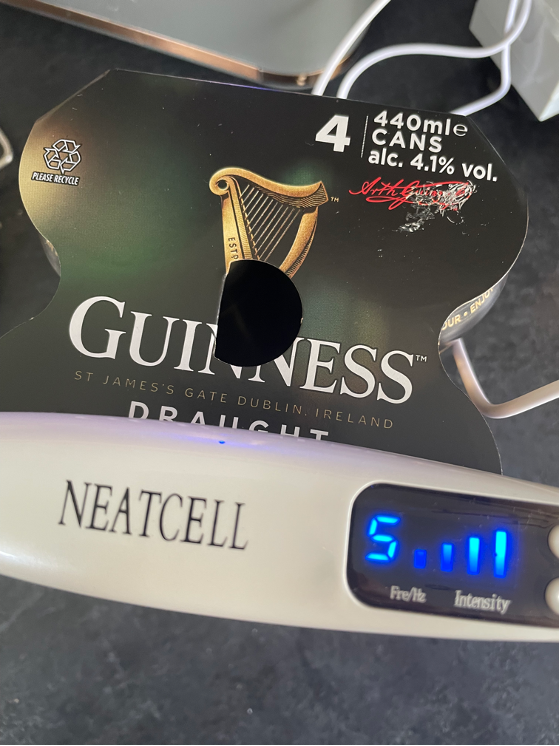
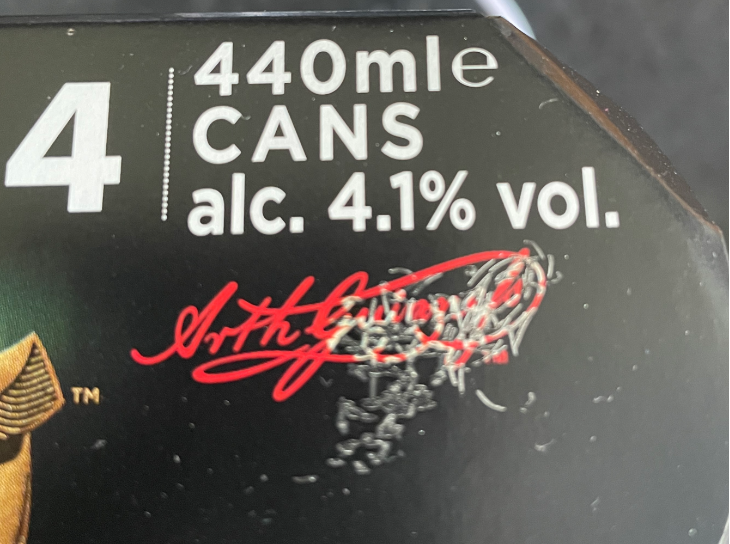
As we can see, it made some small markings in the ink and there was a little smoke generated. But it is nothing like a proper laser burn. But, staring at the light while it was burning the paper was not a good idea.
The spot size is very small. Coupled with the blue wavelength this energy will not penetrate far into the dermis at all. I seriously doubt it could reach most tattoo ink.
I then fired it at my skin (with no tattoo). I could definitely feel a heating sensation, even at the lower power setting. At the highest setting, it felt quite painful.
I also fired the light energy at some water – it made zero impression. No steam or even vapour! Not enough energy…
Incidentally, I noticed something quite curious – the 1Hz setting was much faster than 1 Hz, while the 9Hz setting was nowhere near 9Hz!!
My opinion
I have a number of concerns:
- I’m not sure if this device is actually a laser. It emits an intense blue light which can be generated by an LED;
- It is definitely NOT a picosecond pulsewidth;
- I have no idea what sort of energy/fluence it actually delivers;
- This blue wavelength will be strongly absorbed in epidermal melanin. It will induce pain and may cause damage;
- The output frequency does not match the screen settings;
- No safety glasses are provided, even though it clearly does have a detrimental effect on the retinas;
- It appears to merely ‘burn’ its targets.
If it is truly a laser, then it must be a Class 4 device, if their claims are accurate. In that case, it MUST be supplied with the correct safety glasses, otherwise they are breaking the law in the UK and the EU.
After just a very few shots I could clearly see ‘images’ due to the high intensity of the blue light. These are typically described as ‘flash burns’, similar to exposure to camera flashguns.
My conclusion
It’s a waste of money. It may diminish the appearance of a tattoo, but most likely through the creation of scar tissue.
Hope this helps,
Mike.


 Mike Murphy's Blog
hey man thanks for the information as you stated it doesn’t come with goggles so I thought it was OK to use it without I used it for a couple hours now am I going to go blind ?
No. The energy is too low but I wouldn’t look directly down the barrel!
Probably not, but I wouldn’t continue to use it without the proper safety glasses.
Hello, my friend has nevus ota, he using neatcell almost 2 year, the result is amazing, i can send you if you want proof, email me
What is your emal address?
very interesting. What glasses or goggles would you recommend using with the device airing on the side of caution incase its putting out some power. I have one and used it on a rather dark mole. After two go’s its almost vanished. I did it with a dark towel and scarf rapped around my head to cover my eye and i looked away. But even with the towel the room lights up like a nuclear bombs gone off. The mole cleared up nicely after the scab fell off. Ive not used it since the experiment as im worried about my eyes and the wall paper. Theres a few things id like to burn off but i could do with some decent goggles
Hi Steve,
That is interesting. Blue light will damage melanin-based targets like moles. Did you check it out with a doctor before using this device?
As for the correct glasses to wear, I honestly don’t know. Without knowing the actual power/energy output it is difficult to calculate the correct optical density for the glasses!!
I’m sorry…. maybe I missed something in this review… Are you saying you did NOT test this equipment on an actual tattoo??? I’m terribly confused how you could possibly make any reliable assessment without…? I’m an esthetician and aesthetic laser certified…. worked with various modalities for 15+ years… maybe I misunderstood the review? Please clarify?
also … “laser” is a frequent term for at home devices and is used very loosly…. almost **ZERO** at home OTC aesthetic modalities are ACTUAL “LASERS” … More so the are classified as IPL’s …. (laser is just a term easier for mass pop to have a better idea/ understanding of the otc device… )
I tested it on my own, non-tattooed skin. This device emits an intense blue light – this is entirely not suitable for tattoos. Blue light cannot penetrate far into the dermis and so will have little effect on tattoo inks. It is a completely pointless device!
Hi Jordan,
I would not let this device anywhere near a tattoo!! It is far too dangerous on the skin, without the presence of ink (which could makes things a lot worse).
This device is definitely NOT a laser – it looks like a bunch of blue LEDs. It is completely useless for this aplication. In fact, since I wrote my review, the UK government has withdrawn it from sale in the UK due to safety concerns.
I hope that clarifies things for you.
I agree with you fully and we should make sure we let people know this is a scaring device that burns and should always seek professional advise and use approved FDA technology.. Regard kplasertattoo.com
Blue laser is for colored ink red laser is for black
This device is not a laser!