
Many of you probably already know that leaving longer intervals between laser tattoo removal sessions usually means that more ink disappears. I first noticed this in 2019, after treating my son-in-law. But it was confirmed after the Covid lockdowns, when many treatments stopped across the world.
Many laser operators posted up photos of quite unexpected ink clearances 12 to 18 months after a previous treatment. So, I contacted a number of these laser centres and asked for more details.
I collated these data and results and got it published in the Journal of Dermatology Research – https://doi.org/10.46889/JDR.2024.5211
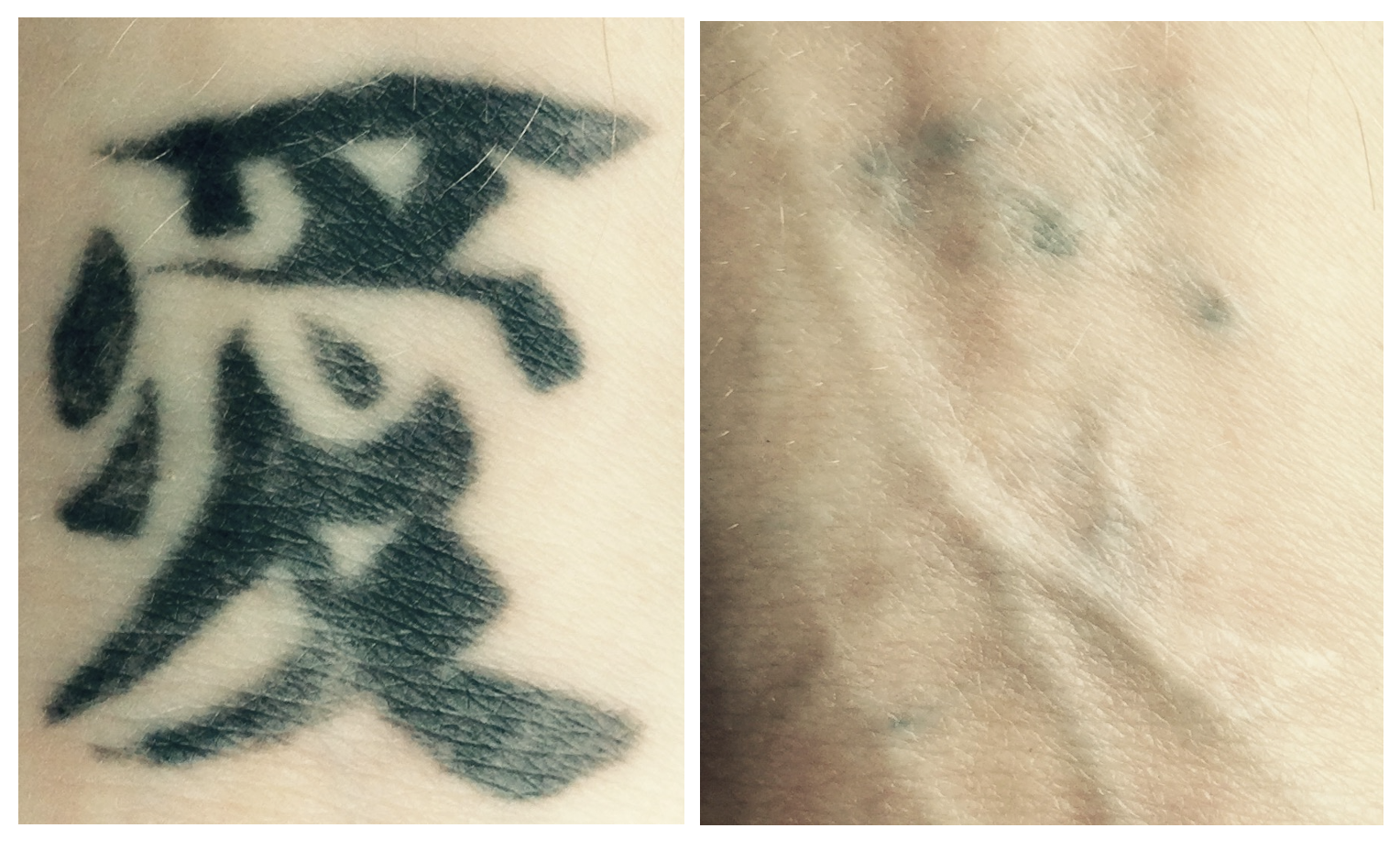
The above show my son-in-law’s tattoo before treatment, and after four sessions. Those sessions were spaced out over 51 months, and the second photo was taken seven months later (nearly five years after the first session). This was treated with a Q-switched Nd:YAG laser.
The paper lists the results from a variety of lasers – Nd:YAG, Alex and ruby – using either nano- or picosecond pulsewidths. It appears that the technology is not as important as we previously thought! Leaving longer gaps between treatments is an important factor too. This is most likely due to the time it takes the skin to repair the damage caused by the laser and the time it takes to physically remove the ink particles.
Of course, this will vary significantly between individuals, but it appears that leaving longer times will usually result in more ink clearance. I should point out that if your laser is a piece of crap, it still won’t work properly, regardless of how long you leave…
Very, very interesting…
While this is all very interesting, I realised something that is truly very interesting while writing this paper. After a tattoo is first injected into the skin, it takes around three to four months for the skin to get back to some sort of normality (in most cases).
The ink particles aggregate together and are consumed by lymphatic and dermal macrophages. Some of the ink is removed to the lymph nodes, while most of it remains in the skin – encapsulated inside dermal macrophages. These cells have a typical lifetime of around 30 days, at which point the ink is released back into the dermis, and new lymphatic and dermal macrophages take care of it.
Tattoos fade, in this manner, very slowly. If the bearer lived to be, perhaps, 400 years old, their tattoo would eventually fade away completely.
But….
I realised that this process changes after laser treatment. These results in my paper clearly show that ink continues to be removed from the site for many months after a laser intervention. This implies that something in the ‘repair’ process has changed! If the normal process occurred after a laser treatment, the fading would stop within three to four months. It doesn’t!!
I don’t understand why this happens – I’m not a physiologist. I’d love to know what is happening here, so, if you have an idea, please let me know.
Summary
There are many factors which appear to affect laser tattoo removal. We tend to focus a lot on the technology and give scant regard to the physiology. I think this is a mistake. The data present in my report clearly shows that the physiological processes which occur after laser treatment of tattoos are also important. I suspect there may be more to this than currently meets our eyes.
Hope this helps,
Mike.
PS Our next MasterClass will be held in London on November 3rd and 4th 2024. If you would like some information, please email us at DermaLaseMasterClass@gmail.com.



 Mike Murphy's Blog
Very good blog; thank you very much. It certainly makes us think!
Could it perhaps be that, due to the laser temperature/heat, the surrounding damaged tissue and cells become overly stimulated and excited to such an extent, that the trauma is far more then we believe, meaning the phagocytosis never actually settles until many, many months have passed? Because the ink particles are now newly relocated particles, they might need an additional settling period of another 3 months before any removal continues once again.
After all, if the QS emitted light reaches thousands of degrees and could potentially travel some 20km, or so, do we fully understand exactly how much trauma we’re causing (& the true repair response mechanisms) into a small area of say 5-10cm3?
As you recall, we removed a complete tattoo in only 6 treatments [similar to your amazing cited experience above, of a record only 5tx] but this was only achieved successfully by spreading it over 3 long years [2tx pa].