
Here we go again! Fitzpatrick – the most mis-understood concept in laser/IPL therapies.
Everyone who does laser/IPL treatments on the skin talks about the “Fitzpatrick”. Yet most people don’t really know what it means! Here is my take:
There are two things you MUST understand:
- The “Fitzpatrick” is the skin’s response to ultraviolet radiation.
Dr Fitzpatrick was an American dermatologist who devised a scale back in 1975 based on his skin cancer patients (You can find out more here). He wanted to find a way to determine how likely a patient was to develop skin cancer after sun exposure. So, he worked out his scale which later became known as the ‘Fitzpatrick Scale’.
It has NOTHING to do with skin colour or tone!!!
He noted that ‘red-skinned’ people were much more prone to skin damage due to UV light energy – they are “Fitz 1”. They are not ‘pale’ or ‘fair’-skinned people. They have high levels of pheomelanin which reacts much more aggressively to UV light than eumelanin, which most people have an abundance of. (We all have a mix of both eumelanin and pheomelanin).
“Fitz 2” and “Fitz 3” people have low levels of eumelanin meaning that they have little natural protection against UV light energy, until they generate more melanin (a sun tan!) Consequently, they are more prone to tissue damage if exposed to UV light.
“Fitz 4” have more natural melanin, typically, meaning that they are better protected against UV.
“Fitz 5” have higher levels of consistent melanin meaning that they have good levels of protection. Finally, “Fitz 6” people have the highest levels of UV protection since they have very high melanin content in their skin, most of the time. They are least likely to suffer any serious consequences of UV exposure since they are very well protected already.
Your ‘Fitzpatrick’ cannot change, regardless of the colour or tone of your skin. It is a genetic trait – you are born with it.
However, your skin colour/tone can change significantly due to various factors, including sun exposure, state of health, medication, disease or environment. Your tone changes across your body all the time – the colour of the top and bottom of your hands are different (usually), as are the bottom of your feet. Your armpits are not usually the same colour as your arms, which are usually different on each side.
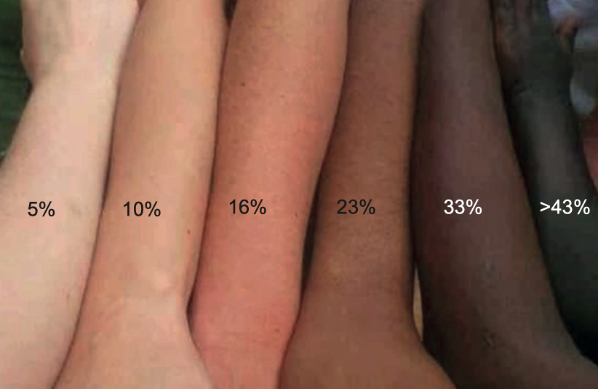
Skin tones depend on the melanin concentration in the epidermis.
When you go on holiday and come back with a sun tan, your skin tone has changed (on parts of your body) but your Fitzpatrick has not.
Finally, we CANNOT measure our Fitzpatrick. I have seen small devices out there which claim to measure your Fitzpatrick (see image below) – that is nonsense. To do that properly, you would need to expose some skin to UV light energy and measure the variation in melanin content over a period of a few days or weeks.
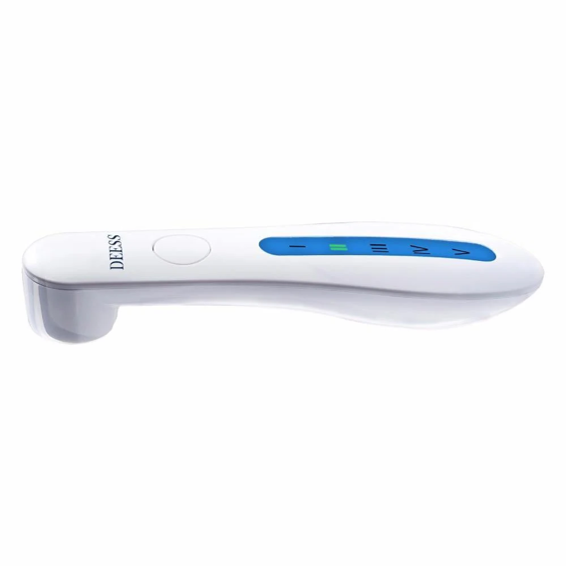
These meters measure the skin colour on that body area, at the time of measurement – nothing more. They DO NOT measure the Fitzpatrick number.
However, these devices may be useful, if used correctly, in determining a skin tone number. This number may give us an indication of the melanin content at that time. This information may be useful when considering laser/IPL treatments – but that’s another post…
2. Do NOT change your fluence according to the ‘Fitzpatrick’!!
When we treat hair with light, we are targeting the eumelanin in the hair shaft (not pheomelanin – this does not absorb red light so readily). We choose a certain level of energy concentration (fluence) which will effectively destroy the germative cells in the follicle, such that they cannot regenerate that hair.
To achieve this, we must deliver the correct amount of energy, otherwise the temperature of the germ cells will not be sufficiently high to ‘cook’ them thoroughly. If there is not energy, those follicles will regrow new, finer hairs in future. These will usually be lighter in colour (thin hairs hold less melanin!) and, hence, become more difficult to kill in future.
So, we must be careful in our choice of fluence – it is the single MOST IMPORTANT choice when treating hair.
How does the skin colour/tone affect this choice?
Unfortunately, this is where many people go wrong. They look at someone’s skin and ‘assess’ their ‘Fitzpatrick’ (incorrectly, as you now know!!). Then they select a ‘Fitz’ button on their device’s screen.
What does that actually do? It’s quite simple – the ‘Fitz’ button decides the maximum fluence you can deliver to the skin. Some engineer in a far-off country (usually) has pre-determined that you cannot exceed some given fluence based on your choice of ‘Fitz’.
That engineer has never met you. He’s never seen your salon/clinic. He’s never met your clients/patients, or seen their skin. Yet, he has decided that you cannot go above some random value on YOUR device.
Imagine if they did that with your car!!! You cannot drive faster than 35 mph because an unknown engineer has decided that for you. You have no choice! Would you be happy with that?
Yet they do that with your laser/IPL device. Some companies actually put a limit on your device, often without telling you. I know who they are…
All this does is limit YOUR ability to obtain good clinical results. Setting a ‘Fitz’ on your device is simply restricting your choices. The higher the Fitz chosen, the less fluence you can deliver. You can easily check this on your own system.
So, what is the answer?
The answer is very simple:
Choose the required fluence depending on the hair depth
and
Choose the amount of pre-cooling with icepacks according to the skin colour.
The skin colour/tone determines how much pre-cooling you must apply before firing your light energy. If you think about it, this makes perfect sense. The melanin in the epidermis is a barrier – we must ensure enough light energy gets through it to reach the real target – the melanin in the hair follicle.
But some of that light energy will be ‘stolen’ by the epidermal melanin and it will become hot, as a result. So, we must pre-cool that epidermal melanin to keep its final temperature down, and prevent damage.
The more melanin in the epidermis, the more pre-cooling we must apply! It’s that simple.
I recommend always applying icepacks for at least two minutes before firing the light energy. I know that sometimes this may be uncomfortable. But I always say – “better to have cold pain than hot pain!!” Cold pain is transient – hot pain may cause permanent damage!
After two minutes, the epidermis will be very cold – around two degrees Celsius. The thermal pain nerves will also be around that temperature.
Then, when you fire the laser/IPL energy, the epidermis and pain nerves will heat up, but they will not be nearly as hot as they may have reached before cooling. Hopefully, enough light energy will get through the epidermal melanin barrier and heat up the hair follicles sufficiently.
You may have realised something here….
Something strange….
Something which goes against everything you’ve learned previously….
If the epidermal melanin is “stealing” some of the light energy, then less is available to reach the dermal targets – the hair melanin. Darker skin tones will ‘steal’ more light than lighter skin tones.
This suggests that we must apply higher fluences on darker skins!!!
WHAT???!?!?!?!?!!?
Yes! It’s true. Darker skins have more epidermal melanin, which steals more light energy, leaving less energy to reach the follicles.
So, they need more fluence to compensate for that loss. But, that means that the epidermis will become even hotter! Which means they need even more pre-cooling.
YIKES!
This is so against everything that we’ve all heard all these years. But the physics is very simple. And true!

So, in a nutshell, here’s what we should do when treating hair:
*******************
Look at the skin colour of the treatment area (use the device above, if you wish)
Find out the maximum hair depth in that site – look it up!
Set your fluence according to the hair depth.
Determine the amount of pre-cooling you need based on the skin colour/tone – minimum 2 minutes – up to 5 minutes for darker skins.
After pre-cooling, treat as normal.
After treatment, cool again with ice packs for a few minutes to extract any excess heat energy (there will be lots!!).
*******************
I am assuming that you are only treating ‘dark’ hairs here!! No blond, grey, red, white or light brown!!
The above method is good for ALL devices, regardless of wavelength. The excess heating in the skin must be dealt with properly regardless of the technology you use!
Caveat – There is a point where pre-cooling will not be sufficient due to the melanin content of the skin. In very dark skins, there is simply too much melanin – we would need to push the local temperatures to below zero Celsius to have a beneficial effect – that’s not a good idea. Those skin tones must be treated with the long-pulsed Nd:YAG laser only! Alexandrites, diodes and IPLs will most likely induce too much thermal damage in such skin colours.
Summary
It’s quite simple – do not choose your fluence according to the skin colour – that is absurd! You choose it according to the hair you are trying to remove.
Choose the pre-cooling time according to the skin colour. Always use ice cold ice-packs with gel (it’s messy, but it’s worth it) – they are the most efficient way to cool the skin.
Happy heating….
Hope this helps,
Mike.


 Mike Murphy's Blog
Would it help if a bleach is done a day or two before doing laser
NO!!!! Bleach will damage the skin.