
Whilst chatting to a young lady about her laser hair removal issues, I thought of a better way to explain why treatments often don’t work.
I realised that we need to visualise the skin as a sequence of ‘zones’ –
the ‘kill’ zone where the hairs will always be successfuly destroyed;
the ‘stun’ zone where the follicles are stunned but not properly killed;
and the ‘null’ zone where nothing much happens to the hairs.
This idea applies to everything we treat in the skin – blood vessels, tattoos, dermal pigmentation etc.
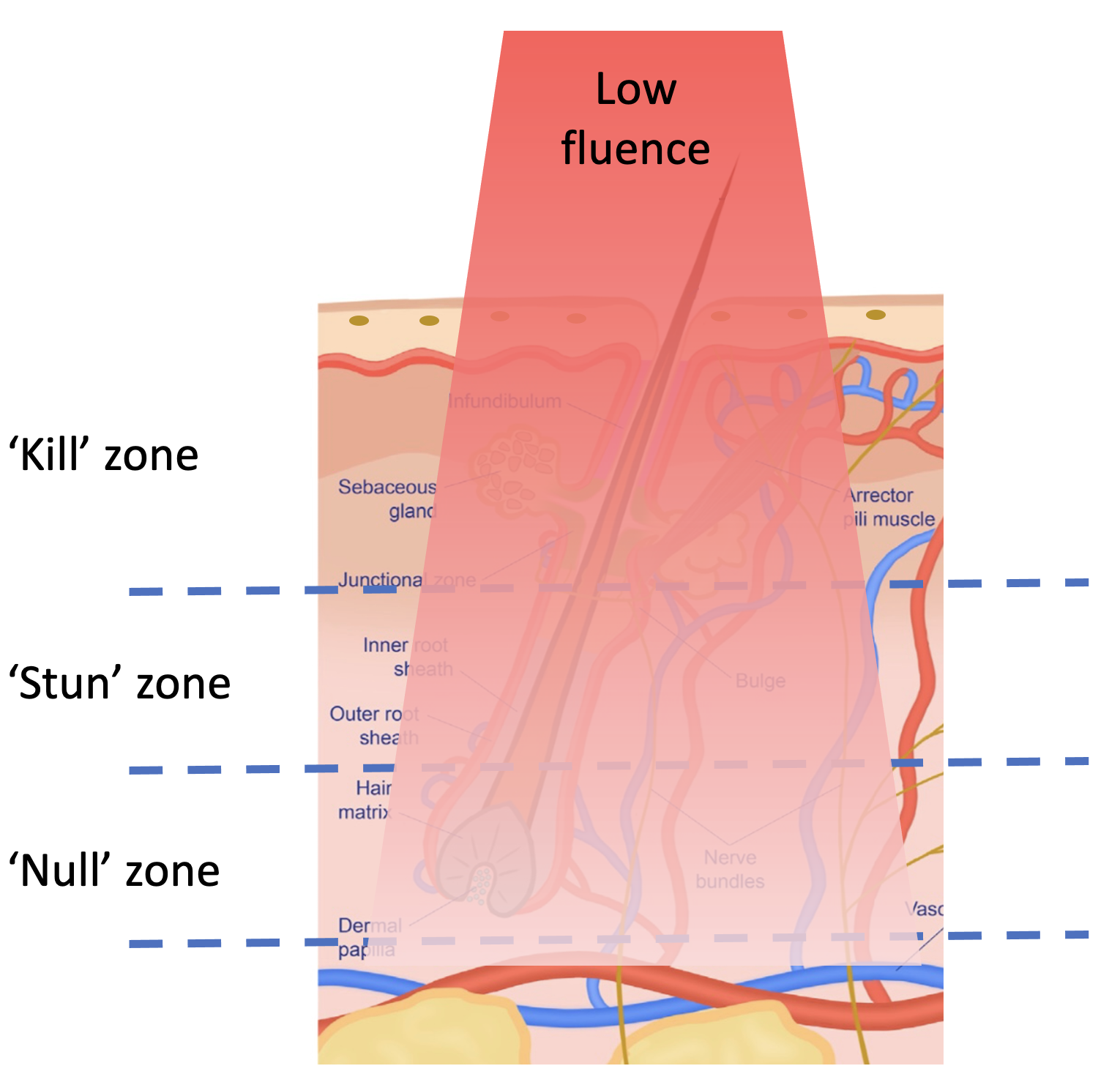
If we fire a relatively ‘low’ fluence into the skin, then the effectiveness of this fluence will permeate to some depth. The targets down to that depth should be properly cooked. But, just below that effective kill zone, the fluence will be too low to have the desired effect on the follicles. Some of the germ cells will be cooked, while some will remain alive. These surviving cells will re-generate those follicles in the next anagen phase and grow finer, lighter-coloured hairs. Below that zone is the null zone, where the fluence is now so low that it merely ‘warms’ the follicle germ cells but has no real effect on them. Those hairs will survive this treatment easily.
Clearly, this ‘low’ fluence will not kill all the follicles since the energy reaching the deeper hairs is just too low. So, we need to increase the fluence to push down the depth of the kill zone (see image below).

A higher fluence will have more effect throughout the dermis since more energy can reach the deeper regions. The kill zone is now larger (deeper) than the previous low fluence. Any follicles down to the new depth should be properly killed. The stun and null zones are also now deeper, and smaller since the dermis is finite in size. In fact, our aim should be to fire a sufficiently high fluence so that all of the full-thickness dermis is a kill zone. In that way we ensure the highest chances of success. This is especially true for those regions of the body where the deepest hairs are found – the underarms and bikini areas. We must use higher fluences there to be sure we are killing all the follicles, otherwise, thinner hairs will re-grow over time. Of course, higher fluences always require more pre- and post-cooling to protect the skin and minimise pain.
The above is true for all wavelengths (all devices) and skin tones. It’s simple physics! If we don’t get sufficient fluence down to the follicle germ cells, then they will survive.

I’ve just completed a new booklet for free download on the removal of hair using lasers and IPLs. In it I describe the use of lasers and IPLs for permanent hair removal. I also mention the above KSN Zones and some information on nerve desnities across the body.
You might find it useful.
I am currently writing a series of these small booklets on various topics including laser safety, tattoo removal, blood vessel treatments etc.
Hope this all helps,
Mike.
PS Our next MasterClass will be held in Liverpool on June 2nd and 3rd. If you are interested in joining us, please write to lisa.dermalase@gmail.com.



 Mike Murphy's Blog
You’re the best! I hope that one day I can figure out a way to come take one of your courses. It would be an honor. ❤️