Many laser and IPL operators become concerned when a client experiences what appears to be “full regrowth” after several treatments. In reality, this often represents a normal and potentially beneficial biological response.
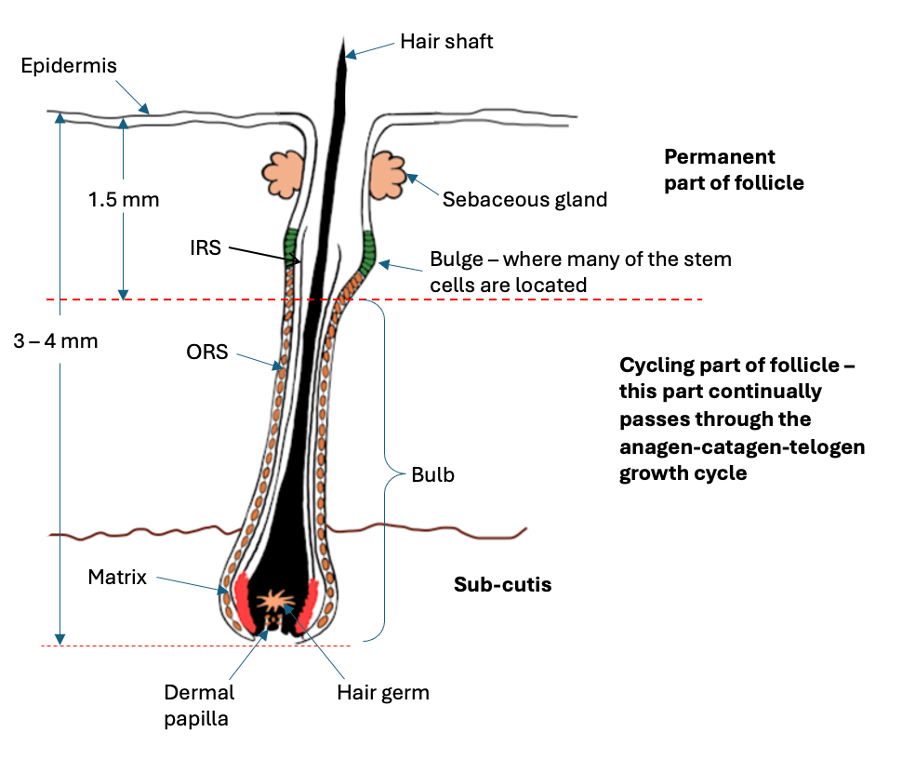
Hair follicles cycle through growth (anagen), regression (catagen) and resting (telogen) phases. However, not all follicles are equally treatable. Laser and IPL treatments work best when sufficient melanin is present around the dermal papilla (DP), particularly within the follicular matrix.
Importantly, a hair does not need to be visible above the skin surface to be treatable. Follicles in late anagen stages may already contain sufficient melanin to absorb laser energy, even if the hair shaft has not yet emerged.
After treatment, some follicles are permanently destroyed, while others may be temporarily injured and enter a resting phase. These surviving follicles can later re-enter growth together in a more synchronised fashion. This may produce the appearance of “regrowth”, even though many follicles have already been permanently removed.
Synchronised regrowth is therefore not necessarily a sign of treatment failure. In fact, it may represent the best treatment opportunity, because a larger proportion of follicles are simultaneously in a treatable state.
This helps explain why clients often experience their best long-term results after several sessions. It also explains why occasional hairs may still appear years later: some follicles may have been dormant or untreatable during the original treatment course.
The key message for laser and IPL operators is simple:
Regrowth does not always mean failure. Sometimes it means the remaining follicles have become synchronised and are now more vulnerable to treatment. In fact, you could achieve an excellent response if you hit those synchronised follicles hard!
Incidentally, many poeople confuse synchronised growth with paradoxical hypertrichosis (PH) – they are not the same thing. PH occurs on areas where there has been no laser/IPL treatments – synchronised growth appears where there had.
Hope this helps,
Mike.