
I recently presented two talks at the recent BMLA annual meeting (Solihull, May 2026), and the response was genuinely encouraging — good questions, real engagement and a sense that at least some people in the room were ready to challenge the orthodoxy. But the orthodoxy is still very much out there, deeply embedded in training courses, manufacturer guidelines and clinical practice. So let me spell it out here, plainly.
There are two related myths I want to tackle. They are connected, and both of them are
causing real harm to treatment outcomes.
Myth 1: Match your pulsewidth to the thermal relaxation time of the target
This idea has been with us since Anderson and Parrish published Selective Photothermolysis in 1983. And to be fair to them, it was a reasonable starting hypothesis. The concept was that if you deliver your pulse of energy within the time it takes the target chromophore to lose half its heat to the surrounding tissue — the thermal relaxation time, or TRT — you maximise energy confinement and minimise collateral damage.
It sounds logical. It got into textbooks. It got into training courses. And it has been repeated so many times that most operators treat it as settled physics.
But, it isn’t.
The TRT rule was derived from simplified theoretical assumptions to the heat equation. When you apply numerical modelling to what actually happens inside a hair follicle during a laser or IPL pulse, the picture is far more complex. The follicle is not a simple geometric shape sitting in a uniform medium. Heat diffusion is not symmetrical. The relationship between pulsewidth and thermal damage is most definitely not linear. Our Monte Carlo and finite element analyses show clearly that the critical variable for irreversible follicle destruction is not whether your pulsewidth matches the TRT — it is whether you have delivered sufficient fluence to raise the follicle temperature above the denaturation threshold for long enough.
Pulsewidth matters, but not in the way you might think…
Myth 2: Increase your fluence with each treatment session
This one is equally widespread and equally wrong. The logic behind it seems to be that because hair gets finer with successive treatments, you need to work harder to destroy the remaining follicles. So you ramp up the fluence session by session.
The problem is that this approach ignores what is actually happening in the tissue. The fluence required to irreversibly destroy a follicle is determined by the follicle’s depth, diameter and melanin content — not by how many sessions the client has had. If you are not achieving destruction at your current fluence, increasing it incrementally and hoping for the best is not a clinical strategy. That’s just guesswork with a dial.
The main issue with sub-optimal treatments is that the follicles usually survive and grow back later, with finer hairs containing less melanin – making them increasingly difficult to kill next time!
What our numerical analyses show is that there is an optimal fluence range for each target, below which you achieve no permanent damage and above which you risk thermal injury to surrounding structures. The goal from session one should be to identify and apply that optimal fluence — with appropriate skin cooling — rather than starting low and creeping upward over months.
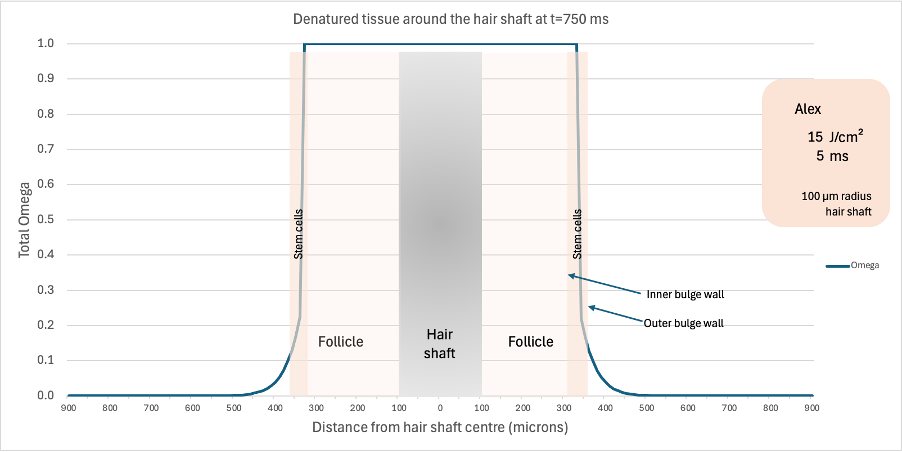
My computer model shows that the fluence is the MAJOR determinant of success. The pulsewidth is relatively trivial.
Why does this matter?
Because clients are receiving suboptimal treatment. Some are receiving none at all — sessions that feel uncomfortable but achieve nothing permanent, because the fluence was never sufficient to reach the denaturation temperature at follicle depth. Others are being over-treated as operators chase results by increasing energy without understanding the underlying physics.
The questions at the BMLA meeting gave me some hope. People are starting to ask why their outcomes don’t match what they were taught to expect. That is the right instinct. The answer lies in the physics, not in the manufacturer’s protocol sheet.
If you want to understand this properly, the two talks I gave at the BMLA meeting are available on YouTube via the link in my previous post. I’d encourage you to watch them, challenge them and come back with questions.
More on this to follow.
Mike.


 Mike Murphy's Blog