Why year-round sunscreen recommendations deserve a more scientific discussion.
For many years, the beauty and aesthetics industry has promoted a familiar message: wear sunscreen every day, throughout the year, regardless of the weather.
We are regularly told that ultraviolet (UV) radiation damages our skin, accelerates ageing and increases the risk of skin cancer. All of this is true.
But is the advice to wear high-factor sunscreen every day equally appropriate in Glasgow in December as it is in July? (Or any other ‘high-latitude’ location?)
And what about vitamin D, which our bodies naturally produce through exposure to UV radiation?
Perhaps it’s time we looked more closely at the science rather than simply repeating the same advice throughout the year.
UVA and UVB: What’s the Difference?
Most therapists will be familiar with the traditional explanation:
- UVA = Ageing
- UVB = Burning
It’s a useful way of remembering the differences, but it’s also an oversimplification.
Both UVA and UVB can damage skin cells, contribute to premature ageing and increase the risk of skin cancer. However, they interact with our skin differently.
UVA: The Ageing Radiation?
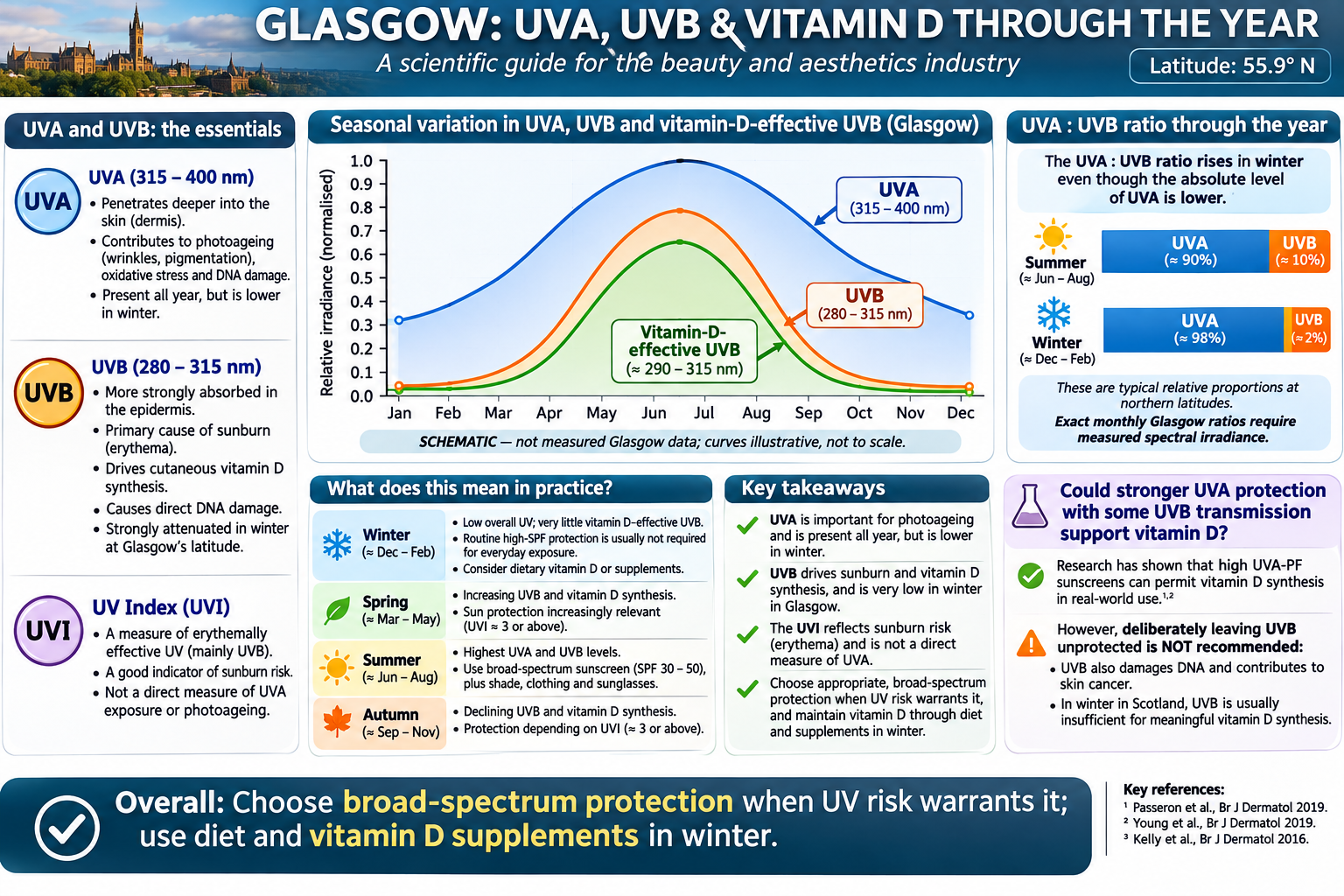
UVA (315-100 nm) penetrates more deeply into the skin than UVB, reaching the dermis, where collagen and elastin are found. It contributes to oxidative stress, pigmentation changes, collagen degradation and premature skin ageing.
UVA is present throughout the year, including during winter. However, contrary to a commonly repeated claim, UVA intensity is not constant throughout the year.
In Northern Europe, winter UVA levels are substantially lower than summer levels.
UVB: The Burning Radiation?
UVB (280-315 nm) is more strongly absorbed within the epidermal melanin. It is particularly effective at producing sunburn and directly damaging DNA – much more visually obvious than any UVA damage. However, UVB also performs an essential biological function.
UVB energy initiates the production of vitamin D in our skin.
When UVB photons interact with a molecule called 7-dehydrocholesterol in the epidermis, they initiate a series of reactions that eventually produce vitamin D₃.
Vitamin D is essential for calcium regulation, bone health and normal muscle function.
This presents us with an interesting biological dilemma.
The same radiation that can damage our DNA also enables our bodies to produce an essential vitamin.
The ‘Importance of Geography’
Consider Glasgow, situated at approximately 56 degrees north. During summer, the sun rises relatively high in the sky, allowing substantial amounts of UVB radiation to reach the ground.
During winter, the sun remains much lower. Sunlight must travel through a much greater thickness of atmosphere, where UVB is strongly attenuated, particularly by ozone.
Consequently, the amount of UVB reaching our skin falls dramatically.
Between approximately October and March, sunlight in Scotland is generally insufficient for meaningful vitamin D synthesis.
Yet UVA energy continues to reach the ground, although at considerably reduced intensities. This means the relative proportions of UVA and UVB change throughout the year.
Winter sunlight contains a greater proportion of UVA relative to UVB, even though the absolute intensity of both is reduced.
That distinction is important when considering photoprotection.
What Does the UV Index Tell Us?
The UV Index (UVI) is an internationally recognised measure of the potential for solar UV radiation to cause sunburn. We can all access this number easily now on our smart phones! It takes account of the different biological effectiveness of UV wavelengths. The World Health Organization generally recommends sun protection when the UV Index reaches 3 or above.
At UVI values of 0–2, special sun protection is not normally necessary for everyday outdoor activities. In Glasgow, winter UV Index values are frequently around 0–1.
During summer, they can reach approximately 5–7.
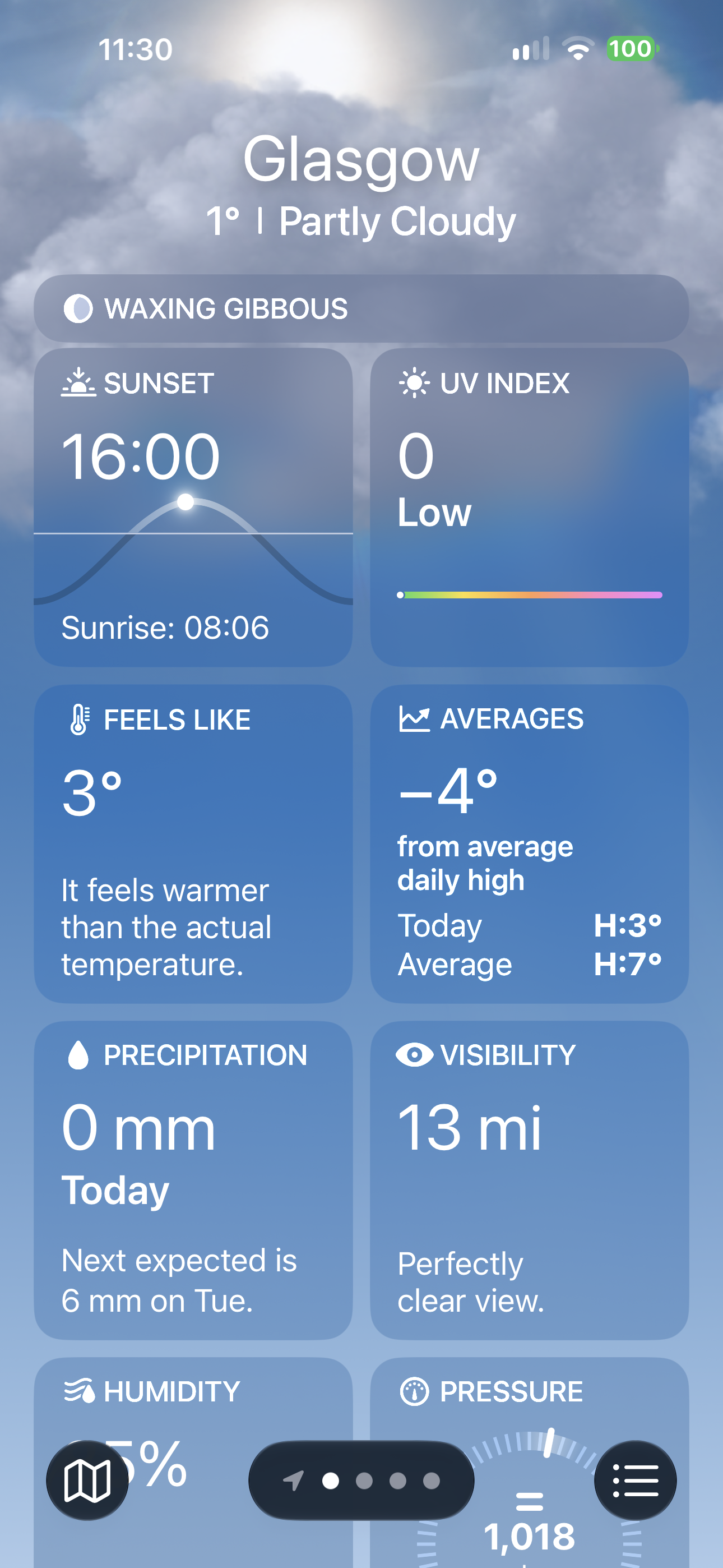
Left image – A lovely day in Glasgow with a UVI of zero! (21st November 2026)
That’s an enormous seasonal difference. Yet the advice commonly presented to consumers remains unchanged: apply SPF 30 or SPF 50 every morning.
Is that always proportionate to the actual exposure?
There is an important qualification here. The UV Index primarily reflects sunburn risk, which is mainly induced by UVB energy. It does not directly measure UVA exposure or the potential for cumulative photoageing.
Nevertheless, it provides a useful starting point for assessing the need for protection.
Are We Overlooking Vitamin D?
This is perhaps the most important public-health issue. Vitamin D deficiency and insufficiency are recognised concerns in Northern Europe. In Scotland, government guidance recommends considering vitamin D supplementation throughout the year, with particular emphasis on autumn and winter. The standard recommended intake for adults is 10 micrograms (400 international units) daily.
Unfortunately, the beauty/aesthetics industry spends considerably more time discussing sunscreen than it does explaining vitamin D. We regularly encourage clients to purchase skincare products to protect against UV exposure throughout the year, yet how often do we discuss their vitamin D intake?
Of course, sunscreen and vitamin D supplements serve entirely different purposes.
One protects against harmful radiation; the other helps maintain adequate vitamin D status.
But both deserve attention when discussing skin health and general wellbeing.
Importantly, deliberately exposing unprotected skin to UV radiation is not necessary to maintain adequate vitamin D levels. Dietary sources and supplements can provide vitamin D without the associated UV-induced DNA damage.
Does Sunscreen Prevent Vitamin D Production?
In laboratory conditions, high-SPF sunscreen substantially reduces the UVB reaching the skin. We would therefore expect it to reduce vitamin D synthesis. However, studies examining sunscreen use in everyday life frequently find little or no significant reduction in vitamin D status.
There are several possible explanations…
People rarely apply sunscreen at the thickness used during laboratory testing. They also miss areas, fail to reapply and continue to receive some UVB exposure. In fact, studies have revealed that the claimed values of SPF, “30” and “50” are essentially meaningless in the real world, for these reasons! A more accurate attenuation factor is the square root of those numbers – in other words an SPF 30 is closer to an attenuation factor of 5.5, while an SPF of 50 is nearer 7!!
Therefore, the theoretical effects of sunscreen are not necessarily the same as those observed in everyday use.
This is an important distinction. We should not automatically assume that someone using sunscreen regularly will become vitamin D deficient.
Should We Change the Balance of UVA and UVB Protection?
Here’s an interesting possibility. Conventional sunscreens are generally designed to provide protection against both UVA and UVB. But given that the proportions of these wavelengths change throughout the year, should the balance of protection change too?
For example, could a winter sunscreen provide particularly strong UVA protection while allowing greater UVB transmission?
In theory, such a formulation is possible.
It might help protect against UVA-associated photoageing while permitting more vitamin-D-producing UVB to reach the skin.
However, there is a problem. During a Scottish winter, the amount of vitamin-D-effective UVB reaching the ground is already extremely small. Allowing more of it through a sunscreen may therefore produce little additional vitamin D. The situation could be different during spring and autumn, when more UVB becomes available.
But allowing additional UVB transmission also increases exposure to radiation capable of damaging DNA. Consequently, we cannot assume that a UVA-selective sunscreen would provide a better overall health outcome.
This is an interesting research question, not yet a recommendation for clinical practice.
It would be worthwhile investigating whether different seasonal sunscreen formulations could provide useful protection while supporting vitamin D synthesis, without increasing harmful exposure.
What About the Cost of Sunscreen?
There is also an economic question worth considering. Many consumers purchase premium SPF 50 facial products and use them every day, including throughout the darkest winter months.
For someone living in Scotland, the Nordic countries, Canada, and the Arctic spending relatively little time outdoors during winter and without particular photosensitivity concerns, the additional benefit of daily high-SPF sunscreen may be modest. That does not mean sunscreen is useless in winter.
People with photosensitive conditions, particular pigmentation concerns, a history of skin cancer or prolonged outdoor exposure may have good reasons to maintain protection.
But perhaps consumers should be encouraged to consider their actual exposure rather than automatically assuming that the highest SPF is necessary every day. Meanwhile, vitamin D supplements are generally inexpensive and address a recognised nutritional concern.
The sensible approach is not to replace sunscreen with vitamin D supplements, but to understand when each is useful.
What Should Therapists Tell Their Clients?
I believe our industry should move towards a more individualised, evidence-based approach. Rather than simply telling everyone to wear SPF 50 every day, we should explain the factors that determine UV exposure and risk.
These include geographical location, season, UV Index, time spent outdoors, skin tone (in this case your “Fitzpatrick” is important!), medical history and the individual’s particular skin concerns. For most people, sun protection becomes especially important when the UV Index reaches 3 or above.
Broad-spectrum sunscreen, protective clothing and shade all have important roles.
For those particularly concerned about photoageing, good UVA protection may remain desirable even when the UV Index is low.
And in Northern Europe, adequate vitamin D intake deserves much greater attention, particularly during winter.
Conclusion: Let’s Teach the Science, Not Just the Slogan
UV radiation is neither entirely harmful nor entirely beneficial. Its biological effects depend on wavelength, intensity, exposure duration and the characteristics of the individual.
UVA and UVB behave differently in the atmosphere and interact differently with our skin.
Their relative proportions also change considerably throughout the year, particularly at northern latitudes.
The familiar advice to wear sunscreen every day is straightforward and easy to communicate. But simplicity should not prevent us from explaining the underlying science.
We should also remember that low UV exposure does not mean zero risk, and that the benefits of reducing cumulative photoageing may differ from the benefits of preventing sunburn.
Perhaps the most useful message for our industry is this:
Understand the UV Index. Understand the differences between UVA and UVB. Protect your skin appropriately. And don’t forget vitamin D.
Rather than teaching clients to fear that nasty sunlight, we should help them understand it – embrace it. After all, good aesthetic practice should always begin with good science.
Hope this all makes sense,
Stay safe and Vit D up!
Mike.

Suggested scientific references for further reading:
- World Health Organization — Global Solar UV Index: A Practical Guide.
- World Health Organization — Ultraviolet radiation and health.
- NHS Scotland / Food Standards Scotland — Vitamin D supplementation guidance.
- Passeron T. et al. (2019). Sunscreen photoprotection and vitamin D status. British Journal of Dermatology.
- Young A.R. et al. (2019). Optimal sunscreen use, during a sun holiday with a very high ultraviolet index, allows vitamin D synthesis without sunburn. British Journal of Dermatology.

We will be discussing this topic in our “Lasers in Skin” podcast soon.