
Understanding Your Fluence Recommendations
A guide to what the ‘Fluence Range Recommender’ App is doing, and why
| In short… The app is built on real physics and biology, not guesswork – based on three of my computer models which I have worked on over the last 20+ years. It works out how much light energy needs to reach the important parts of a hair follicle (the stem cells in the bulge and the dermal papilla cells at the base of the follicle) to switch it off permanently, without overheating the skin surface — and it adjusts that for the device, the client’s skin and hair, and the part of the body being treated. |
What are we actually trying to switch off?
A hair follicle keeps producing hair because of two small structures buried in the skin:
- The bulge — a reservoir of stem cells partway down the follicle, a bit like the “factory” that keeps regenerating the hair.
- The dermal papilla (DP) — a cluster of cells right at the base of the follicle that signals the hair to keep growing, like the “switch” that tells the factory when to run and when to stop. This is, essentially, the ‘nerve centre’ of a follicle – it drives the growth process.
For hair removal to be permanent, both of these need to be heated sufficiently high, for long enough, to be permanently disabled. Heat one but not the other, and the follicle may recover or the hair can miniaturise rather than stop altogether — which is why an aggressive-looking result straight after treatment doesn’t always mean the job is done.
A hair only absorbs enough light to be treated while it’s in its active growth phase (called anagen). In fact, my research has found that sufficient melanin only exists in the mid- to late anagen phase. This is the best time to hit hair follicles. Hairs that are telogen (resting) or in catagen have far less pigment in the matrix cells (which surround the DP cells) and largely pass the energy straight through. Since not all hairs on a given area are in anagen at the same time, no single session can ever catch every hair — this is the biological reason multiple sessions, spaced corrrectly, are unavoidable, not a shortcoming of any particular device.
Why fluence, depth and colour all matter together
“Fluence” is simply the amount of light energy delivered per unit area of skin (measured in J/cm²) – incidentally, its correct scientific name is “radiant exposure’! Three things determine whether that energy actually reaches and damages the bulge and DP:
- Wavelength — different wavelengths are absorbed differently by the pigment (melanin) in the epidermal basal layer and in the hair shaft, and travel to different depths in skin before they’re absorbed or scattered away.
- Depth — the bulge and DP sit at different depths depending on the body site and how coarse the hair is. Light energy weakens with depth, so deeper targets need more fluence at the skin surface to receive the same effective dose. Coarser hairs usually means deeper hairs.
- Pigment and skin tone — darker hair absorbs more energy (which is good for the target) but darker skin tones also absorb more energy at the surface (which raises the risk to the epidermis and more pain). This is why the same settings can be perfect for one client and unsafe for another with a different skin tone (note — NOT “Fitzpatrick” — that means something else altogether!!).
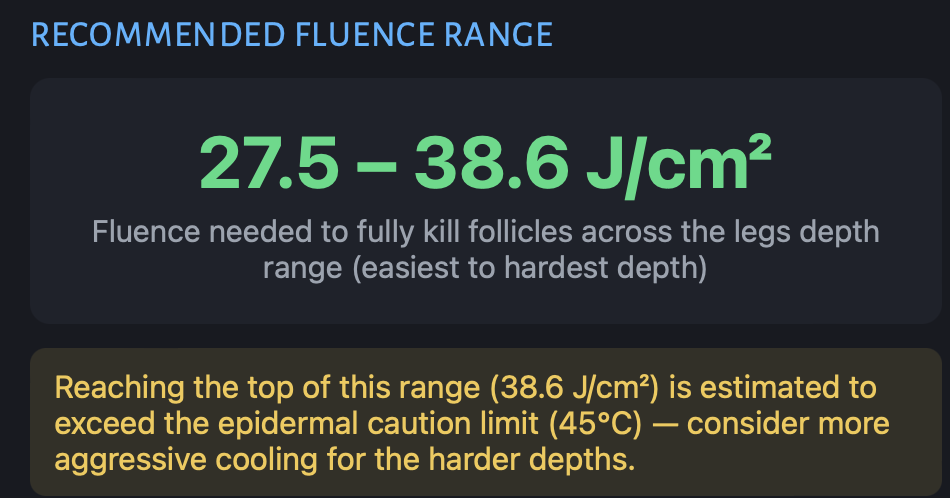
The app’s “recommended fluence range” is the span of fluence needed to fully treat every hair depth typically found at the selected body site — from the shalloewst hairs down to the deepest ones — using the physics above rather than a rule of thumb, based on my models.
Why the app asks what it asks
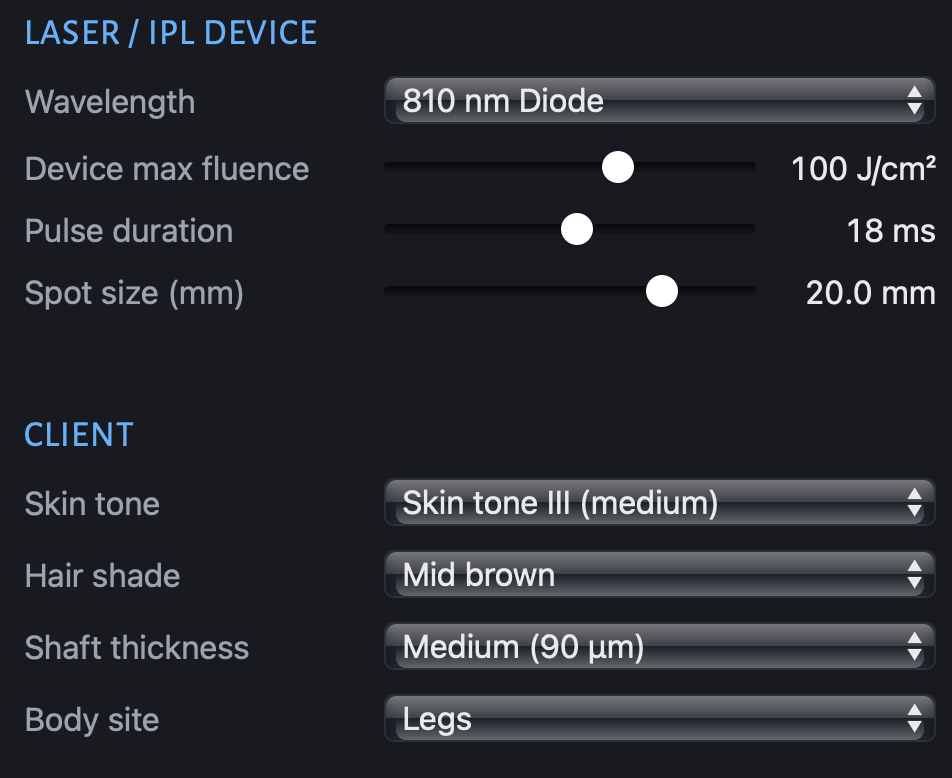
| Setting | What it’s really doing |
| Wavelength / device | Sets how strongly the light is absorbed by hair pigment versus basal layer pigment, and how deep it can reach. |
| Device max fluence | The ceiling/maximum your specific equipment can actually deliver — used to check if the recommended range is actually achievable. |
| Pulse duration | Controls how quickly heat builds up versus how much time it has to spread away from the target before the pulse ends. Most devices display this. |
| Spot size | Larger spots scatter less at depth, so they deliver relatively more energy to deeper targets than small spots do. |
| Skin tone | Sets how much energy is absorbed at the skin surface — directly affects both safety and how much energy actually reaches the follicle. Darker skin tones allow less light energy through to the dermis than lighter ones! |
| Hair shade / thickness | Lighter or finer hair holds less pigment and less thermal mass, so it needs a different balance of settings to reach the same result. |
| Body site | Sets the typical depth range of the bulge and DP at that site, and the hair growth-cycle timing used for the retreatment interval. |
Keeping the skin surface safe

Whatever setting is used, some of that energy is inevitably absorbed in the outer skin layer (the basal layer in the epidermis) on its way to the follicle. The app estimates the peak temperature this causes at the surface, and flags it if it’s likely to exceed a safe working limit — this is a modelled estimate, not a measurement, so it should be read as an early-warning indicator rather than a guarantee.
Cooling the skin beforehand (an ice pack, or your device’s built-in cooling) protects the surface while barely affecting the temperature reached deeper down at the follicle — which is why the app gives a recommended ice-pack time based on skin tone: darker skin tones absorb more energy at the surface and so benefit from a little more cooling time beforehand.
Cooling the skin after the treatment is arguably more important – it draws out excess heat energy from the dermis more rapidly than air. If heat is trapped in the skin, it will cause thermal trauma. It must be removed as quickly as possible to minimise unwanted damage.
| Skin tone VI For the darkest skin tone (VI), the app will only recommend a wavelength if it’s Nd:YAG (1064 nm) — the one wavelength that passes through melanin-rich skin with the least surface absorption. Every other device is flagged as ‘not appropriate’ for this skin tone, because the risk of surface burns and pigment change is considered too high regardless of the fluence chosen. |
Why the interval between sessions matters
Hair follicles cycle through three phases: a growing phase (anagen, when the follicle can be treated — but only in part of it!), a short transition phase (catagen), and a resting phase (telogen). The recommended interval between sessions is judged against how long the growing phase typically lasts at that body site:
- Too short an interval, and you’re mostly re-treating hairs that were already caught last time, rather than catching newly-growing ones — more appointments for little extra benefit. On some occasions, you might be treating an area with virtually no anagen follicles at all!!
- Too long an interval, and a hair can grow, mature and pass out of its treatable growing phase entirely between visits, missing it altogether.
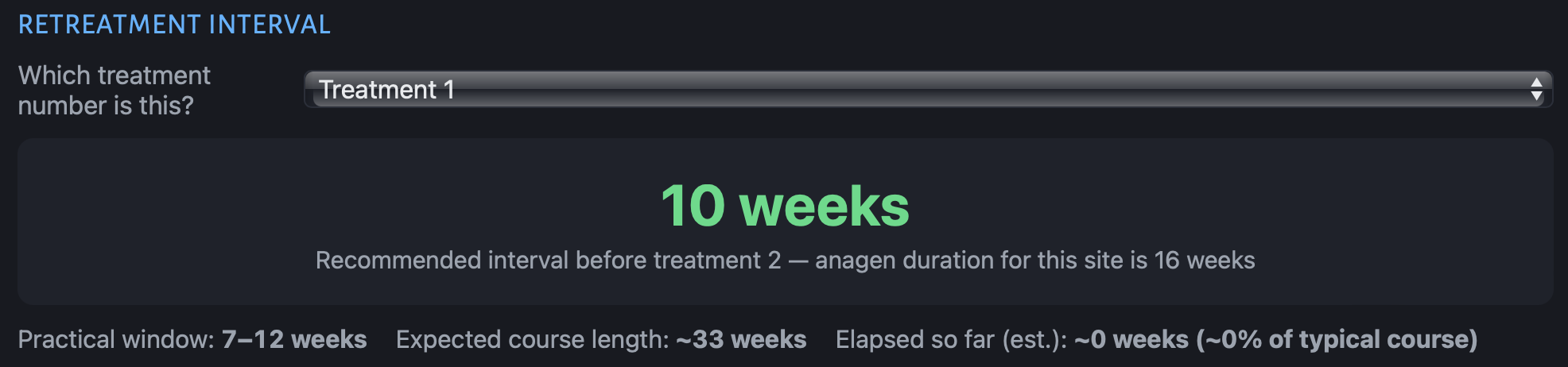
The app’s recommended interval sits comfortably inside that window for the selected body site, and it also gives a realistic expectation for how many weeks a full course is likely to take — which is set mainly by how long the resting phase lasts at that site, more than by how often sessionshappen.
Finally, what this app is — and isn’t
- It is a physics- and biology-based estimate, built from published research on how light, heat and hair follicles interact and my computer modelling work over the last 20+ years.
- It is a starting point for professional judgement, not a replacement for it — always follow your device manufacturer’s guidance and your own clinical training – but only if it works for you!! If you need more training, you know where we are…
- Every client is an individual. Hair coarseness, true skin response, healing and device condition all vary in ways a general model can’t capture perfectly for any one person in the chair.
- If a recommendation looks unusual for a case you know well, that’s worth a second look rather than an automatic override in either direction.
Produced by Mike Murphy, Dermalase Training Academy to accompany the Fluence Range Recommender app, v1, – as a “guide” for laser/IPL operators. September 2026
This app must be used as a ‘guide’. Use your own clinical judgement to assess whether the recommended fluence is applicable in each situation – it may not be due to particualr circumstance, which no app can predict!
Please let me know how you get on with it.
Ciao for now,
Mike.




What’s the name of the App?
Brenda Musia Phone: (713) 816-5834