When we’re taught above lightin the sin, we’re usually told that its intensity drops (exponentially!) with depth. So, as a result, deeper targets are more difficult to heat than superifical ones.
That makes sense – kind of…
But this is not a true representation of what is realy going on. There are a few things which can occur:
- Between around 4 and 7% of any light hitting the skin surface is reflected – it never enters the skin;
- As soon as light enters, it encounters many, many atoms. For the wavelengths we typically use, that means a lot of scattering. The photons are sent in many directions, at all sorts of angles.
- Many of those scattered photons leave the skin altogether – those are the ‘back-scattered’ photons.
- The scattering causes any beam of light to spread out significantly as it penetrates deeper into the skin. The beam’s diameter increases and, so, the fluence drops – rapidly!
- The wavelength of the incident light determines how much scattering (and back-scattering) will occur. Near-infrared light can lose up to 60% of the light energy purely due to back-scattering.
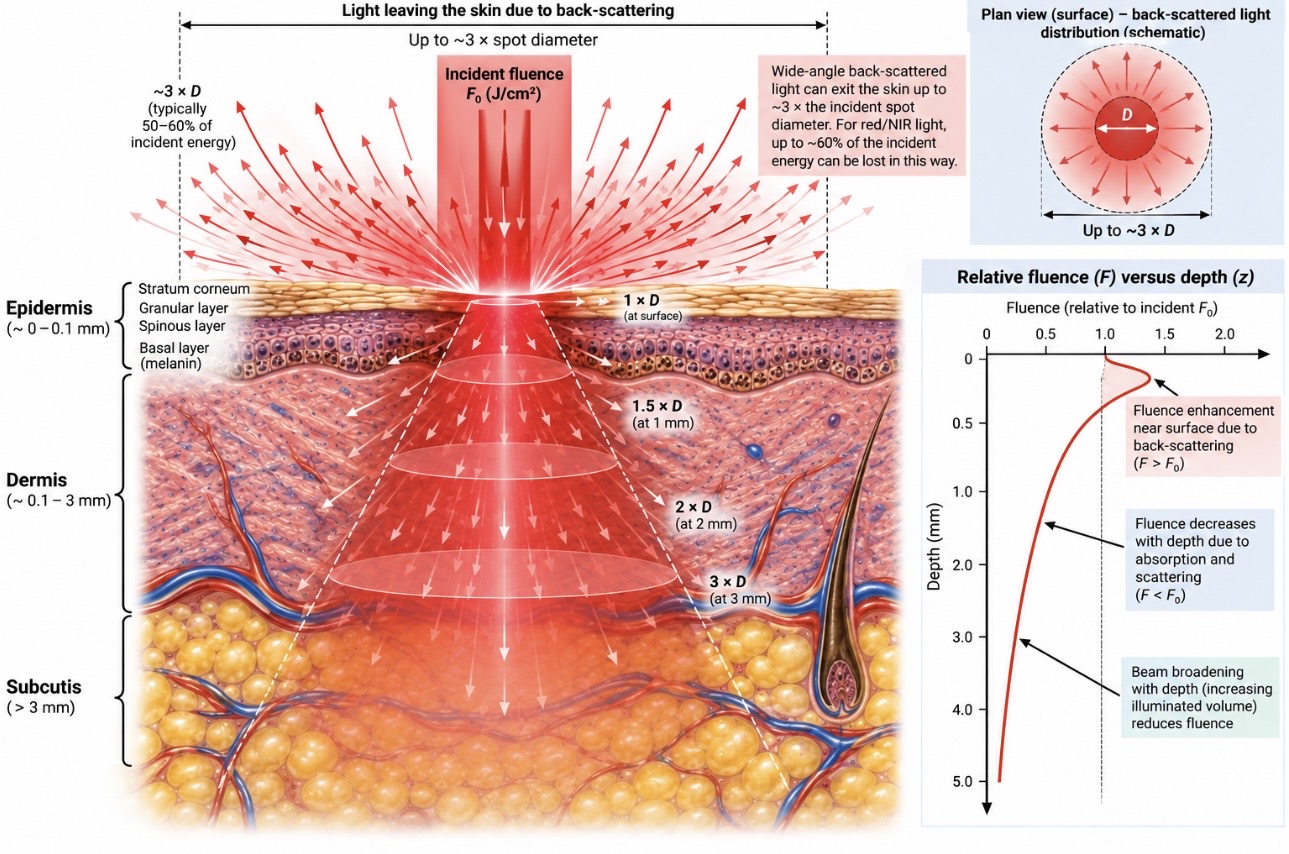
The panel at the bottom-right is also very interesting. Becuase many of the photons are scattered towards the skin surface, they ‘meet’ incoming photons on their way down. This can result in an increase in the fluence at superficial depths in the skin – the fluence there can reasily exceed to fluence at the skin surface.
Of course, not much will actually happen unless those photons are absorbed by some chromophore…
So, as you can see, the journey of these photons in the skin is actually quite interesting. It is not simply a case of “the fluence drops” – that is too naive a picture. The real picture is much more nuanced and alters the way we should think about treatments.
Hope this helps,
Mike.

PS You can hear me gibbering on and on about this kind of stuff on our podcast – “Lasers in Skin”